
Aluminum fence panels are the fastest-growing segment of the Canadian fencing market, and for good reason. They cost nothing to maintain, survive decades of freeze-thaw cycles without cracking or warping, and install 30 to 50% faster than site-built wood fences. Whether you are a contractor quoting your next residential job or a distributor evaluating product lines, this guide covers the styles, costs, installation methods, and performance data you need to make an informed decision about aluminum fence panels in Canada.
What Are Aluminum Fence Panels and Why Do Canadian Contractors Prefer Them?
Aluminum fence panels are pre-assembled fence sections made from extruded 6063-T6 aluminum alloy, designed to mount between posts for residential, commercial, and industrial perimeter fencing. Canadian contractors prefer aluminum panels because they resist corrosion in freeze-thaw conditions, require zero repainting, and install faster than site-built wood fences.
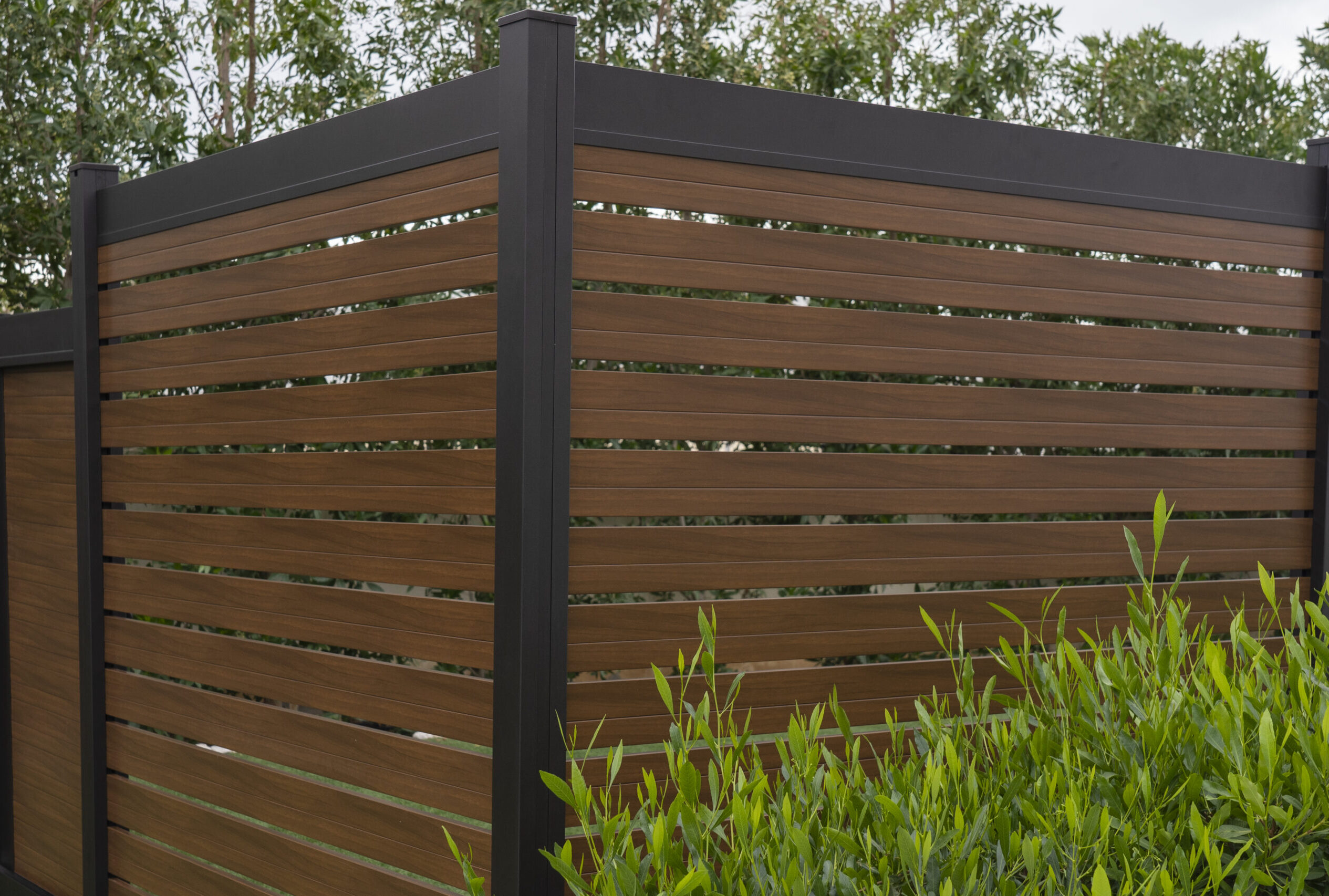
PrimeAlux horizontal aluminum fence panel in Natural Walnut wood-grain finish.
The global aluminum metal fencing market was valued at USD 4.98 billion in 2023 and is projected to reach USD 7.97 billion by 2032, growing at a 5.5% CAGR (Verified Market Research, 2024). That growth is driven by exactly what Canadian property owners and contractors deal with every year: harsh weather, rising labour costs, and clients who want a fence that looks good for decades without maintenance callbacks.
Aluminum panels come in three main configurations: privacy panels with zero-gap slats for full seclusion, semi-privacy panels with controlled gaps for airflow and partial screening, and ornamental picket-style panels for decorative perimeter fencing. PrimeAlux manufactures all three, with panel sizes ranging from 4’x6′ up to 8’x8′ and custom dimensions available on request.
For contractors and distributors reading this, the key selling point is simple: aluminum panels eliminate the warranty callbacks and maintenance complaints that plague wood and vinyl fence installations in Canadian climates.
How Much Do Aluminum Fence Panels Cost in Canada?
Aluminum fence panels in Canada typically cost $30 to $70 per linear foot for materials, depending on panel height, style, and finish. Fully installed aluminum privacy fencing runs $110 to $160 per linear foot including posts, hardware, and professional labour. A standard 100-linear-foot residential project totals $11,000 to $16,000.
According to Angi’s 2026 cost data, aluminum fencing averages $29 to $42 per linear foot for materials alone, with installation labour adding $40 to $80 per linear foot depending on terrain and complexity. Canadian pricing tends to run 10 to 15% higher than U.S. averages due to shipping logistics and regional labour rates, with Alberta and British Columbia seeing the highest increases at 4 to 7% year over year (HomeStars, 2025).
Cost Comparison: Aluminum Panels vs Other Fence Materials
| Material | Material Cost (per lin. ft) | Installed Cost (per lin. ft) | Lifespan in Canada | Annual Maintenance Cost |
|---|---|---|---|---|
| Aluminum (privacy) | $40 – $80 | $110 – $160 | 25 – 50 years | $0 (hose rinse) |
| Pressure-treated wood | $15 – $35 | $50 – $90 | 7 – 10 years | $150 – $400 (stain, repairs) |
| Cedar wood | $20 – $45 | $55 – $100 | 8 – 12 years | $200 – $500 (stain every 2-3 yrs) |
| Vinyl (PVC) | $20 – $40 | $45 – $85 | 10 – 15 years | $0 – $50 (but irreparable cracks) |
| Steel | $25 – $55 | $60 – $110 | 15 – 25 years | $100 – $300 (rust treatment, repaint) |
| Chain link | $10 – $25 | $25 – $55 | 10 – 15 years | $50 – $150 (rust, sag repair) |
The upfront cost gap between aluminum and wood narrows quickly when you factor in maintenance. A cedar fence that costs $55 per foot installed needs $200 to $500 in staining every two to three years. Most homeowners skip it, and within eight years the boards are grey, split, and rotting at the base. Aluminum panels from PrimeAlux come with a multi-layer powder coat backed by up to a 20-year warranty, and the total maintenance cost over 25 years is effectively zero.
What Types of Aluminum Fence Panels Are Available?
Aluminum fence panels fall into three primary categories: privacy, semi-privacy, and ornamental. Each serves a different function, and the right choice depends on the property’s requirements for seclusion, airflow, security, and aesthetics.
Privacy Aluminum Fence Panels
Privacy aluminum fence panels use horizontal or vertical slats with zero gaps between them, blocking all line of sight. These are the most popular choice for backyard perimeters in suburban Canadian neighbourhoods where homeowners want full seclusion from neighbours and street traffic.
PrimeAlux privacy panels use 100mm x 20mm slats in an interlocking design that eliminates any visible gaps. The panels are available in heights from 4 to 8 feet and widths from 6 to 8 feet, with 80mm x 80mm posts made from 6063-T6 aluminum alloy with 2mm wall thickness. Every slat receives a three-layer coating: base coat, colour coat, and clear coat for UV and scratch resistance.
Privacy Plus (Reinforced) Panels
Privacy Plus panels are structurally reinforced versions designed for guard-rail applications and high-wind areas. Independent slat load testing confirmed that the reinforced 100mm x 20mm slats support 220 to 363 lbs of horizontal load depending on panel width.
An engineering review by Inventive Consulting Group Ltd (P.Eng. stamped, Dr. Feras Alsheet, December 2024) confirmed these panels meet Ontario Building Code guard compliance pending local authority approval. For contractors bidding on elevated decks, rooftop patios, and balcony applications, this is a direct OBC compliance path. See the full slat load test results.
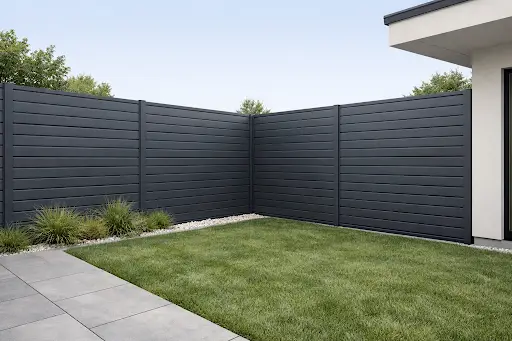
PrimeAlux Privacy panel in black finish, full seclusion with zero-gap horizontal slats.
Semi-Privacy Aluminum Fence Panels
Semi-privacy panels use spaced slats that provide partial screening while allowing airflow and some visibility. These work well for front yards, side yards facing laneways, and pool enclosures where full privacy is not required but some screening is preferred.
Semi-privacy panels are popular for properties in windy areas because the gaps between slats reduce wind load on the fence structure. PrimeAlux semi-privacy panels use the same 6063-T6 alloy and three-layer coating system as the privacy line, so durability and finish quality are identical.
How Do Aluminum Fence Panels Perform in Canadian Winters?
Aluminum fence panels are one of the few fencing materials that actually gain an advantage in cold climates. Aluminum does not crack, warp, or become brittle in sub-zero temperatures, and it is completely immune to the rot and mould that destroy wood fences during spring thaw cycles.
PrimeAlux 6’x6′ privacy panels were wind-load tested to withstand 169.8 km/h winds. Underground-mounted posts handled 226 km/h, and on-ground (base plate) posts held up to 153 km/h. These are verified third-party test results, not manufacturer estimates. You can download the full wind load test report here.
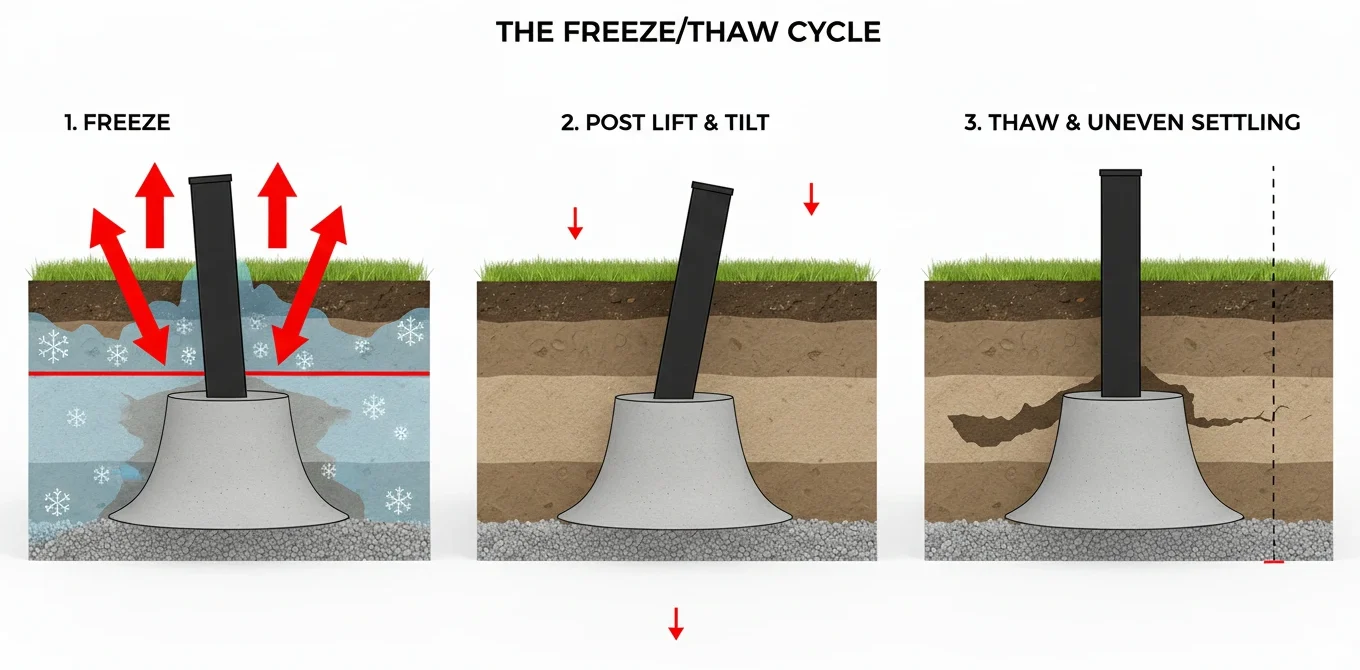
Freeze-thaw cycles are the leading cause of wood fence post failure in Canadian climates.
Compare that to how other materials handle a Canadian winter:
| Material | Freeze-Thaw Performance | Common Winter Failures |
|---|---|---|
| Aluminum (PrimeAlux) | Unaffected. No expansion/contraction damage. | None. Powder coat rated to -40C. |
| Cedar wood | Absorbs moisture, splits during freeze cycles. | Base rot, board cracking, post heaving. |
| Pressure-treated wood | Posts rot below grade within 7-10 years. | Green algae, warping, leaning posts. |
| Vinyl (PVC) | Becomes brittle below -20C. | Cracks on impact, yellowing, cannot be repaired. |
| Steel | Salt and moisture accelerate galvanic corrosion. | Rust at cut ends and below grade, needs repainting. |
According to the Aluminum Association, aluminum alloys retain their full mechanical strength down to -200C, making them one of the few structural metals that actually get stronger in extreme cold rather than weaker. For Canadian contractors, that means zero cold-weather failures and zero springtime warranty calls.
What Colours and Finishes Are Available for Aluminum Fence Panels?
PrimeAlux aluminum fence panels are available in five standard wood-grain colours: Natural Walnut (WU-0384), Grey Walnut (WU-0201), Walnut (WU-0112), Dark Walnut (WU-0497), and Grey Brown (PL-0598). Structural components are powder coated, while slats receive a three-layer coating system for enhanced UV resistance and colour retention.
The three-layer coating process applies a base coat for adhesion, a colour coat for the wood-grain pattern, and a clear coat for scratch and UV protection. This finish is backed by up to a 20-year warranty, which is two to three times longer than the colour warranty on most vinyl fencing products.
Wood-grain aluminum is a growing trend in Canadian residential fencing. Homeowners want the warm aesthetic of natural wood without the maintenance burden. According to the Freedonia Group, demand for decorative and privacy fencing in North America is growing faster than the overall fencing market, driven by homeowner preferences for premium finishes that do not require staining or repainting.
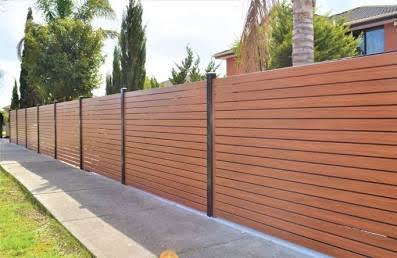
PrimeAlux aluminum slat fence in a wood-grain walnut finish, combining the look of natural wood with zero maintenance.
For contractors, the wood-grain finish is a strong upsell. The colour palette matches popular Canadian architectural styles from modern farmhouse to contemporary minimalist, and clients do not need to choose between appearance and durability.
How Are Aluminum Fence Panels Installed?
Aluminum fence panels install using one of two methods: on-ground mounting with base plates and M8 anchor bolts, or underground mounting with posts set in concrete footings. On-ground installation is faster and works well for hard surfaces like concrete pads and existing patios. Underground installation provides the highest wind resistance and is required for most code-compliant applications.
PrimeAlux posts are available in two lengths: 6.2 ft for on-ground mounting and 9 ft for underground mounting (with 3 ft buried in concrete). The 80mm x 80mm post profile with 2mm wall thickness provides the structural backbone for the system.
Installation Method Comparison
On-ground (base plate): Faster installation. No digging required. Ideal for patios, pool decks, and commercial applications on existing hard surfaces. Wind load rated to 153 km/h with PrimeAlux panels.
Underground (concrete footing): Maximum structural strength. Posts buried 3 ft in concrete. Wind load rated to 226 km/h. Required for guard-rail applications and recommended for open-exposure properties.
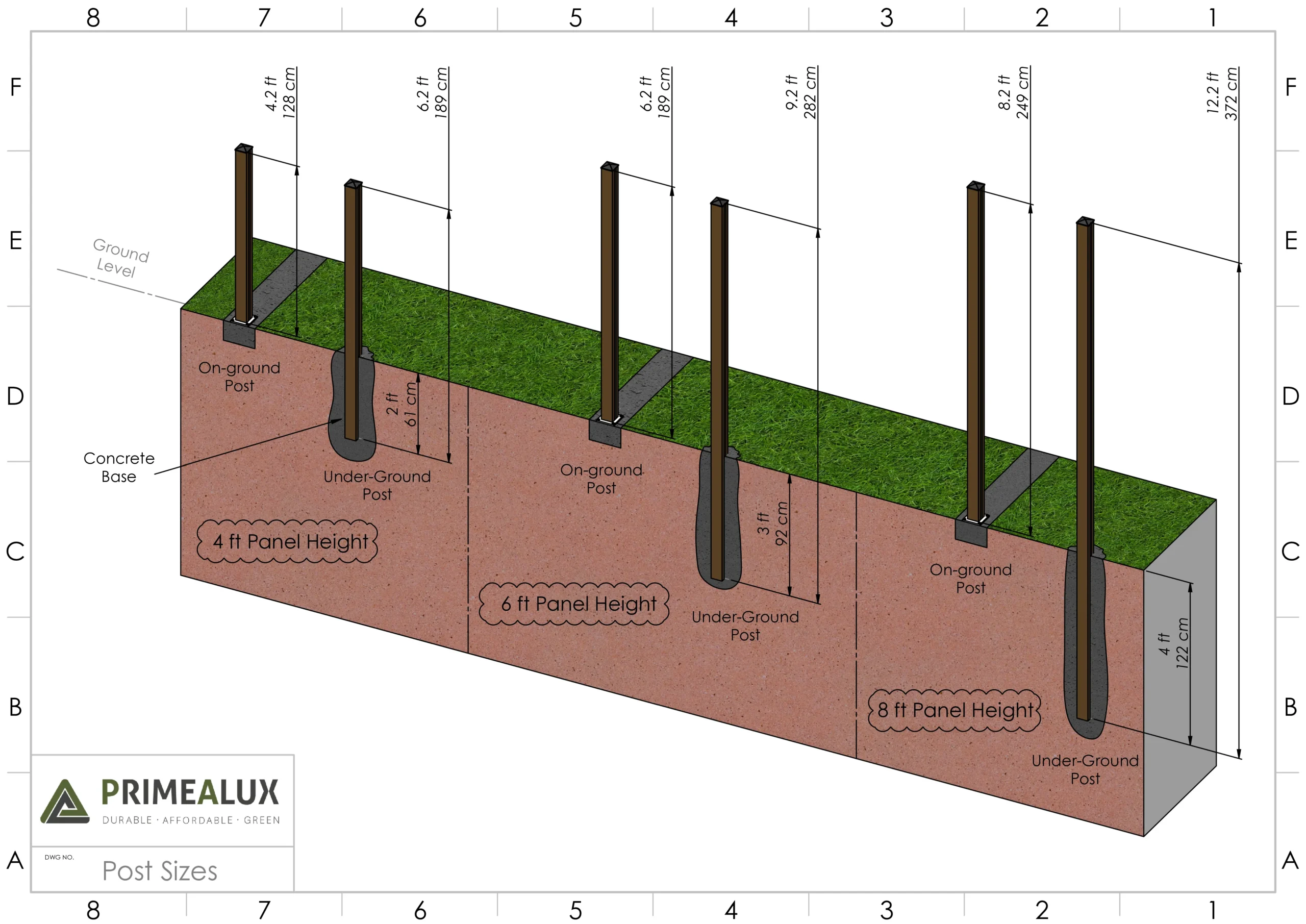
PrimeAlux installation methods: surface-mounted base plate (left) vs underground concrete footing (right).
A typical two-person crew can install 60 to 80 linear feet of aluminum fence panels per day with underground posts, or 80 to 120 linear feet per day with on-ground base plates. That is 30 to 50% faster than building a comparable wood privacy fence from individual boards, which translates directly to lower labour costs per project.
For detailed installation guidance, visit the PrimeAlux FAQ page or contact the team directly.
What Fire and Safety Ratings Do Aluminum Fence Panels Have?
PrimeAlux aluminum fence panels achieved a Class A fire rating under ASTM E84 testing, with a Flame Spread Index of 0 and Smoke Developed Index of 50. This is the highest fire safety classification available for building materials and was verified by Intertek (Report T0044.01-121-24, October 2025).
A Flame Spread Index of 0 means the material does not contribute to flame spread at all. For comparison, untreated wood typically scores 150 to 200 on the same test, and vinyl fencing can produce toxic chlorine gas when exposed to fire. In wildfire-prone regions of British Columbia and Alberta, a Class A rated fence material is not just a preference but an insurance and safety consideration.
PrimeAlux Privacy Plus panels also hold acoustic testing credentials: STC 22 and OITC 19 under ASTM E90, verified by Intertek (Report S8904.01-113-11-R0, 2025). For properties near highways, railways, or commercial zones, this acoustic performance provides measurable noise reduction. See the fire test results and acoustic test results on the PrimeAlux website.
How Do Aluminum Fence Panels Compare to Wood and Vinyl?
Aluminum fence panels outperform wood and vinyl on every metric that matters for Canadian properties: lifespan, maintenance, weather resistance, fire safety, and long-term cost. The only category where wood and vinyl score higher is upfront material cost, and that advantage disappears within five to eight years once maintenance costs accumulate.
According to a 2024 survey by the National Association of Realtors, 65% of real estate agents reported that fencing adds measurable value to a home sale, with privacy fencing delivering the strongest return. The Appraisal Institute of Canada notes that well-maintained outdoor improvements can add 5 to 12% to property value.
Why wood fails in Canada: Cedar lasts 8 to 12 years before major issues appear, including base rot, grey and cracked boards, and warping. Pressure-treated wood fares worse at 7 to 10 years before visible deterioration. Both require staining every 2 to 3 years that most homeowners skip. Posts rot below grade where the damage is invisible until the fence starts leaning.
Why vinyl fails in Canada: Vinyl becomes brittle below -20C and cracks from winter impacts like falling branches and snow loads. Cracked sections cannot be repaired and must be fully replaced. Colour yellows from UV exposure over 10 to 15 years, and replacement panels rarely match the original colour. A 2023 Principia Consulting report on the North American fencing market noted that vinyl’s market share has plateaued as consumers shift toward longer-lasting alternatives.
Why aluminum wins: PrimeAlux aluminum panels last 25+ years with zero maintenance. No rot, no warping, no cracking in cold, no yellowing, no repainting. The multi-layer powder coat is freeze-thaw proof and backed by up to a 20-year finish warranty. For contractors, aluminum means fewer callbacks and higher client satisfaction.
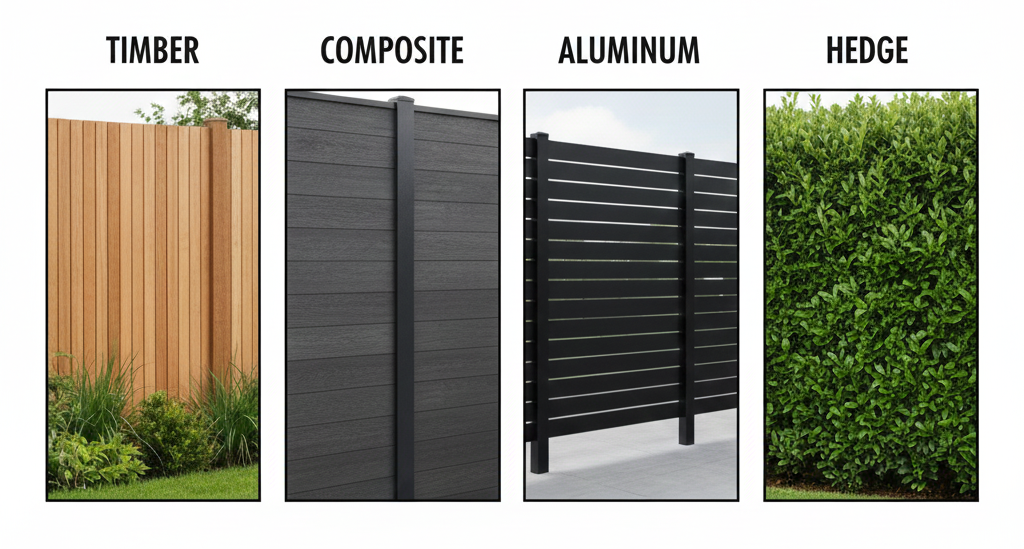
Material comparison: aluminum outperforms wood, vinyl, and composite on lifespan and total cost of ownership.
Where to Buy Aluminum Fence Panels in Canada
Contractors and distributors can source aluminum fence panels directly from PrimeAlux, which manufactures and supplies from Mississauga, Ontario. The company serves contractors, installers, dealers, and distributors across Canada, the United States, and internationally.
PrimeAlux operates a showroom at 2222 South Sheridan Way, Unit 116, Mississauga, ON where contractors can view installed panel samples, compare colour options in person, and discuss project specifications. For pricing and availability, contact PrimeAlux directly.
Product availability includes privacy panels, Privacy Plus panels, semi-privacy panels, pre-assembled aluminum gates, privacy screens, and aluminum sunroof pergolas.
For bulk orders and dealer inquiries, the PrimeAlux team provides volume pricing, sample kits, and technical support for installation training.
Frequently Asked Questions
How long do aluminum fence panels last in Canada?
Aluminum fence panels last 25 to 50 years in Canadian climates with zero maintenance. Unlike wood (7 to 12 years) and vinyl (10 to 15 years), aluminum does not rot, warp, crack in cold, or yellow from UV exposure. PrimeAlux panels use 6063-T6 alloy with a three-layer powder coat backed by up to a 20-year finish warranty.
Are aluminum fence panels more expensive than wood?
Aluminum panels cost more upfront at $30 to $70 per linear foot versus $15 to $45 for wood. Over 20 years, aluminum costs less because it requires zero staining, painting, or board replacement. A wood fence needs $200 to $500 in maintenance every two to three years, while aluminum needs only an occasional rinse with a garden hose.
Can aluminum fence panels be installed on a slope?
Yes. Aluminum panels can be racked (angled within the frame) to follow gradual slopes, or stepped (stair-stepped) for steeper grades. PrimeAlux panels support both methods. Racking works best for slopes under 10 degrees, while stepping is recommended for steeper terrain.
Do aluminum fence panels rust?
No. Aluminum does not rust because it naturally forms a protective oxide layer that prevents corrosion. PrimeAlux panels add a multi-layer powder coat on top of this natural protection. Steel fences rust once the galvanizing wears through at cut ends and below grade, but aluminum is immune to this failure mode.
What is the wind rating for aluminum fence panels?
PrimeAlux 6’x6′ privacy panels were tested to withstand 169.8 km/h winds. Underground-mounted posts held up to 226 km/h. On-ground base plate posts withstood 153 km/h. These are third-party verified results, not manufacturer estimates. Full test data is available at primealux.com.
Are aluminum fence panels good for pool enclosures?
Aluminum is the preferred material for pool fencing in Canada. It meets municipal pool barrier codes, resists chlorine and moisture corrosion, and does not rot or warp from constant water exposure. PrimeAlux semi-privacy panels paired with self-closing gates are a common pool enclosure configuration.
Do aluminum fence panels come pre-assembled?
Yes. PrimeAlux aluminum fence panels ship pre-assembled. Panels slide into posts on site, and gates arrive fully assembled with hinges and latches. This reduces installation time by 30 to 50% compared to wood fences that require individual board attachment on site.
What colours are available for aluminum fence panels?
PrimeAlux offers five standard wood-grain colours: Natural Walnut, Grey Walnut, Walnut, Dark Walnut, and Grey Brown. The three-layer coating system replicates natural wood grain texture while providing superior UV and scratch resistance. Custom colours may be available for large volume orders.
