
Quick Summary
A complete gate hardware kit covers four functional groups: hinges (self-closing or standard), latches (pool-rated, magnetic, or keyed), drop rods or cane bolts for double gates, and weather-resistant fasteners. For aluminum gate systems, contractors should match hardware grade to the gate weight, panel construction, and operational frequency. PrimeAlux gates ship with system-matched hardware tested against the same wind and durability criteria as the panels themselves.
What a Professional Gate Hardware Kit Actually Includes
A professional gate hardware kit is the bundled set of mechanical components needed to hang, latch, and operate a gate reliably for years without realignment. At minimum it includes hinges sized to the leaf weight, a latch mechanism, fasteners, and any supporting hardware (drop rods, gate stops, strike plates) the configuration requires.
Contractors who skimp on hardware almost always pay for it later. A solid aluminum gate hung on undersized hinges will sag within a season. The same principle applies across the matching Privacy Plus panel system and semi-privacy product line. A pool gate without a self-closing, self-latching mechanism will fail municipal inspection and force a callback. The hardware is the difference between a gate that works for fifteen years and one that needs adjustment every spring.
Across the industry, hardware kits fall into three broad tiers. Builder-grade kits use stamped steel components with thin zinc coatings that begin pitting within two seasons. Mid-grade kits add stainless-steel pins and powder-coated bodies. Professional-grade kits, including the matching hardware shipped with PrimeAlux gate systems, use stainless or marine-grade aluminum bodies with sealed bearings and corrosion-resistant fasteners specified to the panel system.
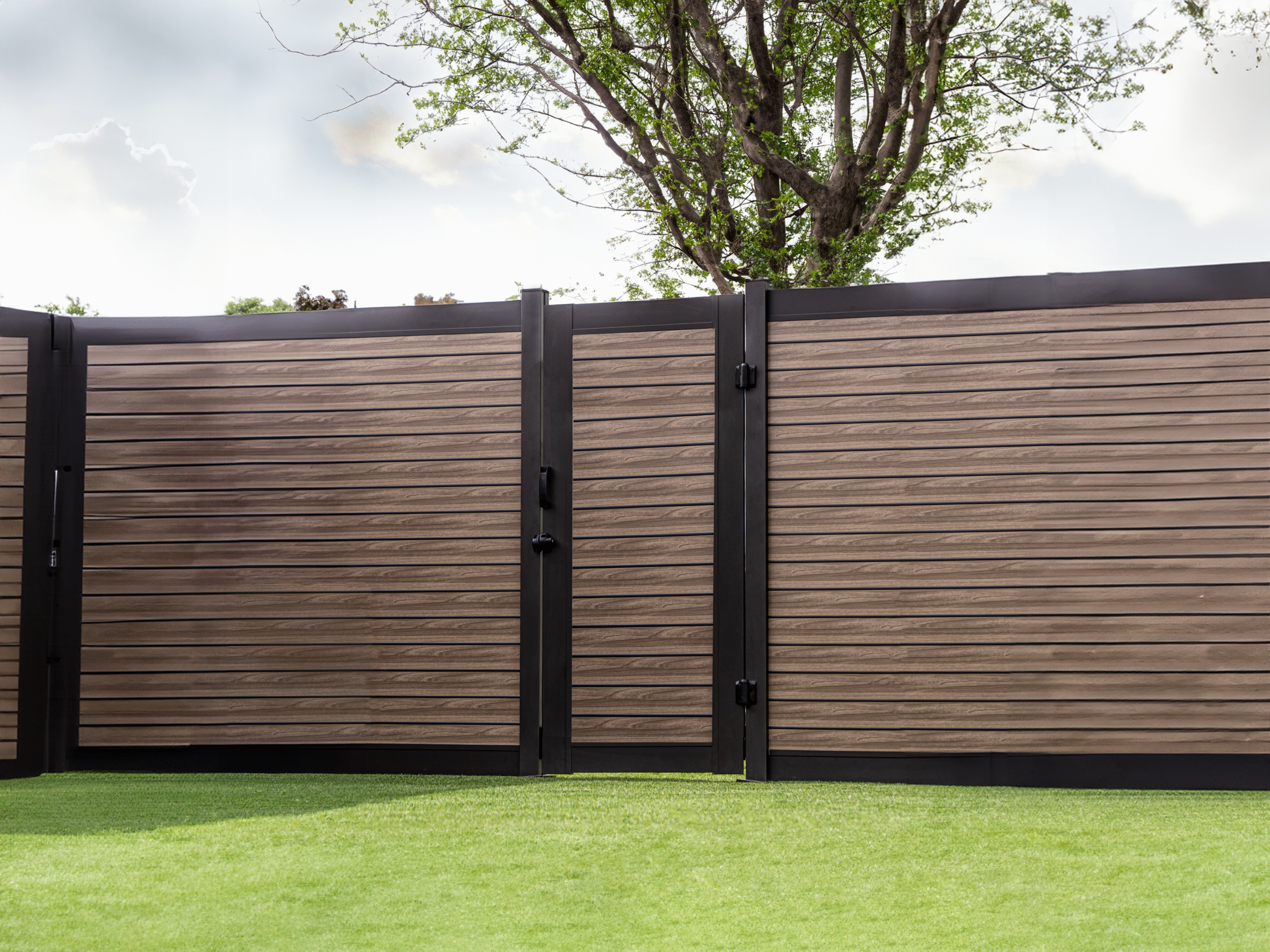
Hinges: Sizing, Type, and Mounting Configurations
Hinges carry the entire load of the gate. Get the hinge wrong and nothing else matters. Three numbers drive hinge selection: gate weight, leaf width, and operational frequency.
For a typical residential aluminum privacy gate panel measuring 4 ft wide by 6 ft tall, the dry weight is roughly 35 to 55 lb depending on the panel construction. Foam-core panels (the construction used in PrimeAlux Privacy Plus) weigh more than open-slat designs. Hinge ratings are published as a load capacity per pair, and contractors should choose hardware rated at no less than 2.5x the gate weight to account for wind loading, slamming, and long-term wear.
Common aluminum gate hinge types include:
| Hinge Type | Best For | Weight Capacity (per pair) | Notes |
|---|---|---|---|
| Standard butt hinge | Light residential gates | Up to 100 lb | Surface-mount, simple installation, no closing function |
| Self-closing spring hinge | Pool gates, child-safety zones | 75 to 250 lb | Required by most pool codes, adjustable closing speed |
| J-bolt hinge | Heavier panels, post-mounted | 200 to 400 lb | Adjustable in three planes, ideal for fine alignment |
| Strap hinge | Wide farm or driveway gates | 300 to 600+ lb | Distributes load across a longer leaf section |
| Bearing hinge (sealed) | High-traffic commercial gates | Varies by spec | Stainless-steel ball bearings, very long service life |
Self-closing hinges are not optional for pool enclosures. Most Canadian provinces and U.S. states reference the International Pool & Spa Code or a state-level equivalent that requires the gate to swing closed and latch unaided from any position. National Safety Council pool barrier guidance echoes the same self-closing, self-latching requirement for residential enclosures. A standard butt hinge will not pass inspection on a pool gate.
For mounting, the contractor’s choice is between surface-mount (bolt-through) and bracket-mount configurations. Surface mount is simpler but less adjustable post-install. Bracket mount, used on most aluminum systems including PrimeAlux gates, lets the installer fine-tune sag, drop, and reveal during the final pass without re-drilling.
Latches: Function Codes, Pool Compliance, and Security
Latches do two jobs: they secure the gate when closed, and they tell the homeowner or operator that the gate is, in fact, closed. The wrong latch creates code violations and security gaps.
The four common categories:
Gravity latches. The simplest mechanism. A weighted arm drops into a strike when the gate swings shut. Inexpensive and reliable, but defeated easily by a child reaching over the top. Acceptable for non-pool applications where security is not a concern.
Magnetic self-latching mechanisms. The current standard for pool gates. The latch engages magnetically as the gate closes and releases by lifting a top-mounted handle. Properly specified models position the release above the reach of small children, satisfying most pool code requirements.
Keyed latches. Secured by a barrel key on one or both sides. Common on commercial properties and shared-driveway installations. Specify keyed-alike sets across multiple gates to avoid the homeowner managing several keys.
Electric strike latches. Used on automated gate systems with intercom, keypad, or RFID access. The strike releases when the controller energizes the solenoid. Coordinate with the gate operator manufacturer; not all latches are compatible with every controller.
For a pool installation in Canada, the latch must release only from inside the pool enclosure or from a height of at least 1.5 m (about 5 ft) on the outside. Verify the local provincial requirement before specifying. Hardware that meets one province’s pool code may not satisfy another.
Drop Rods, Cane Bolts, and Double-Gate Hardware
Single gates need only hinges and a latch. Double gates need a way to immobilize the inactive leaf so the active leaf has something solid to latch against. That job falls to either a drop rod (cane bolt) or a foot-actuated drop bolt.
The drop rod is a steel or aluminum bar that slides vertically into a sleeve cast into the ground or buried in a small concrete footing. Two are typical: one near the bottom of the inactive leaf and sometimes a second near the top engaging into the gate frame. For driveway gates, a single heavy-duty drop rod at ground level is generally sufficient.
Sleeve depth matters. The instructions for PrimeAlux gate kits and most professional systems specify a 6 inch minimum sleeve depth below grade for residential applications, with the sleeve set in concrete during the post installation. In freezing climates, set the sleeve below the local frost line to avoid heave displacing the receiver. For Canadian markets where the frost line ranges from 1.0 m to 2.4 m depending on region according to Natural Resources Canada climate data, set the bottom of the receiver below the established frost depth in the area.
Pro Tip: Drop Rod Sleeves
Cap the bottom of the drop rod sleeve with a small drainage hole or filter fabric so it does not fill with debris. A sleeve packed with dirt and ice will lock the rod above grade by spring. Field crews who skip this step end up grinding rods back open in May.
Fasteners: The Quietest Failure Point in Every Gate
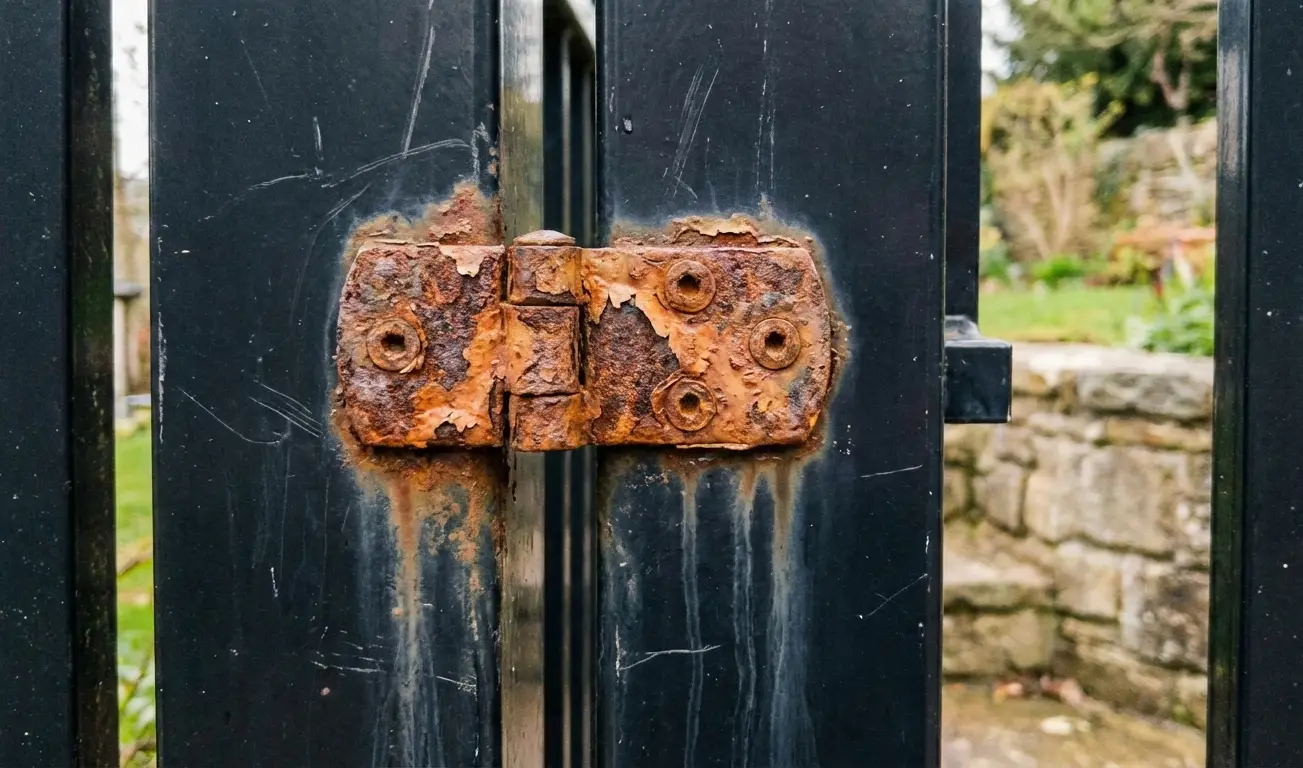
Hinges and latches get the attention. Fasteners cause most of the warranty calls. A correctly specified hinge bolted in with the wrong fastener will pull free of an aluminum post in three to five years. Salt air, freeze-thaw, or any galvanic mismatch accelerates the timeline.
For aluminum gate hardware on aluminum posts, contractors should specify:
Stainless steel fasteners (300-series, typically 304 or 316). 304 is fine for most inland installs. 316 is the standard for coastal or pool-deck applications where chloride exposure is constant, as documented by the ASTM A276 stainless steel specification. The difference in cost is small; the difference in longevity is decades.
Self-tapping screws sized for the post wall thickness. A typical PrimeAlux post wall thickness is between 2.0 mm and 3.0 mm depending on the model. Self-tapping screws should be matched to that wall and torque-controlled at install to avoid stripping or over-driving.
Through-bolts with backing plates for higher-load applications. On commercial gates or any gate with a self-closer, distribute the load with a backing plate inside the post rather than relying on a single threaded engagement. The plate spreads pull-through stress across a larger area of the post wall.
Avoid mixing zinc-plated steel fasteners with aluminum. The galvanic couple between zinc and aluminum is mild but real (see the AMPP galvanic corrosion reference for typical galvanic series data), and in wet conditions it produces white powder corrosion at every contact point within months. The visual is bad, the structural integrity worsens, and the next contractor on the job will flag it. Stainless or aluminum fasteners only. There is no good reason to use anything else on a quality install.
Matching Hardware to the Gate System (vs Sourcing Separately)
There are two ways to put together a gate hardware kit. Either buy hardware bundled with the gate from the panel manufacturer, or source components separately from a fence-supply distributor. Both work; the tradeoffs matter.
System-matched hardware ships with PrimeAlux gates and most reputable aluminum panel manufacturers. The advantages are predictable: hinge bracket spacing matches the post system, fastener sizes match the wall thicknesses, latch strikes match the frame profile, and finish color matches the panel coating. The contractor unbags the kit and installs it. There is no field measurement to size a third-party hinge bracket against the post.
Separate-sourced hardware is cheaper per unit but more expensive in labor. Every component has to be measured against the gate, drilled to fit, and sometimes shimmed to align. Color matching is approximate at best. The savings on materials are usually wiped out by the extra hour or two on the install.
The exception is high-volume commercial work where the contractor is repeating the same gate configuration on dozens of properties. At that scale, dedicated hardware spec’d from a wholesale distributor and pre-kitted in the shop becomes faster than vendor-supplied kits. For most contractor and dealer work (residential, light commercial, or pool), the system kit wins on total installed cost.
For technical reference on matching aluminum gate frames to post systems, the PrimeAlux aluminum gates page documents the available sizes, hinge configurations, and the matching privacy panel systems. For broader spec discussions, the ASTM E84 fire test page lists the supporting documentation contractors and architects request.
Automation Hardware: When to Plan for It and When to Skip
If a property is going automated now or in the next five years, run conduit and rough-in mounting points during the original install. Retrofitting an operator onto a gate that was not designed for it costs three to four times what it would have cost to plan from the start.
For swing gates, plan for a swing-arm or articulated-arm operator. The arm needs clear travel space and a mounting point on the post that matches the operator’s bracket. For sliding gates, the track and roller assembly should be sized for the operator’s pulling force rated at the gate weight plus a safety margin.
Operator manufacturers list compatible hardware in their specification sheets. Reputable brands include LiftMaster, FAAC, BFT, and Nice. Verify the gate hardware kit lists compatibility with the operator the property owner intends to use, or specify hardware known to work across multiple operators if the choice is still open.
For a deeper installation reference covering matching panel and gate systems, see the contractor-facing material at primealux.com/blogs. For a homeowner-side overview of gate types and configurations, the primealux.ca gate page covers the consumer-facing options, alongside the matching privacy fence line.
Common Hardware Failures and What Causes Them
The four failure modes contractors encounter most often:
Sagging gate. Almost always undersized hinges, a gate that exceeds the rated load, or fastener pull-out from inadequate post wall engagement. Diagnosis: lift the latch side and see how much travel exists at the hinge. More than 1/4 inch of slack means the hinges, fasteners, or both are at the end of their life.
Latch not catching. Usually a sagged gate (see above) or a strike plate that has shifted over time. If the gate is square and the strike has moved, retighten or shim. If the gate has dropped, fix the hinge first; the strike will follow.
Self-closer no longer closes fully. Spring tension fades on cheaper hinges. On quality hardware, the tension is adjustable; on builder-grade hardware, the only fix is replacement. This is a good reason to specify adjustable self-closing hinges from the start.
Corrosion at every fastener. The galvanic mismatch problem described above. Once it has started, replace the fasteners with stainless equivalents and clean off the white oxidation. Do not paint over it; the corrosion will continue under the paint.
Frequently Asked Questions
How many hinges does an aluminum gate need?
Standard residential aluminum gate panels up to 6 ft tall and 4 ft wide are typically hung on two hinges sized to 2.5x the gate weight. Gates over 6 ft tall, gates over 4 ft wide, or gates with a self-closer should use three hinges to distribute load and reduce flex at the top of the leaf.
What hardware do I need for a pool gate to pass inspection?
Most North American pool codes require self-closing hinges, a self-latching mechanism positioned at least 1.5 m above grade on the outside of the gate, and a gate that swings outward away from the pool. Verify the specific provincial or state code; requirements vary on latch height, gate height minimums, and inward versus outward swing.
Can I reuse hardware from a wood gate on a new aluminum gate?
Generally no. Wood gate hardware is sized for thicker stock and uses lag-style fasteners that will not engage properly with a hollow aluminum post. Specify aluminum-system hardware sized to the new gate.
What is the lifespan of a quality gate hardware kit?
Stainless-steel and marine-grade aluminum hardware on a properly sized aluminum gate typically lasts 20 to 30 years with no maintenance beyond an occasional rinse. Builder-grade kits with thin zinc coatings start showing pitting in 2 to 4 seasons and structural failure in 6 to 10 years.
Do PrimeAlux gates ship with hardware included?
Yes. PrimeAlux aluminum gates ship with system-matched hinges, latches, and fasteners specified for the panel construction and gate dimensions. Contractors and dealers can request the spec sheet listing every component included in the kit.
Should drop rods be aluminum or steel?
Aluminum drop rods are lighter and corrosion-resistant. Steel drop rods are stronger and better suited for very heavy commercial gates. For most residential and light commercial double-gate applications, an aluminum drop rod with a stainless-steel sleeve insert is the practical choice.
How deep should drop rod sleeves go?
For temperate or non-freezing climates, 6 inches below grade is sufficient. For Canadian and northern U.S. installs, set the bottom of the sleeve below the local frost line. Frost depth typically ranges from 1.0 m to 2.4 m across Canada depending on region; check the local building code.
What is the most common reason a gate sags within the first year?
Undersized hinges. Contractors often spec hinges to the gate weight rather than to gate weight plus dynamic load (wind, slamming, long-term cycling). The fix is hinges rated to at least 2.5x the static gate weight, with three hinges on tall or heavy leaves.
Specifying Gate Hardware on Your Next Project
For contractors and dealers planning aluminum gate work, the practical approach is to start with the gate system spec, then size hardware to that system. PrimeAlux gates ship with matched hardware kits, but for any aluminum gate system the same principles apply: hinges sized to 2.5x the load, self-closing and self-latching mechanisms for any pool or child-safety application, stainless-steel fasteners only, and drop-rod sleeves set below frost line in cold climates.
For project-specific hardware questions or to request a contractor spec sheet for a current build, reach out through the PrimeAlux Canadian office or send the project details to the dealer support team. Spec sheets covering gate hardware kit contents, fastener torque values, and hinge bracket dimensions are available on request and ship as part of the standard contractor onboarding for new dealers and installers.
