
Quick Summary
Automatic driveway gates fall into two main movement types (swing or sliding), three common materials (aluminum, steel, wrought iron), and several automation tiers ranging from manual key-entry to fully integrated access control. For contractors and dealers in North America, aluminum is the practical default for most residential and light commercial driveway installs because it is lighter on hardware, does not rust, and accepts the same wood-grain or matte finishes as the rest of the fence run. This guide breaks down the choices, the code references that affect installation, and the common spec mistakes that cause callbacks.
Why Driveway Gate Selection Drives the Whole Project
A driveway gate is the most visible and most stressed part of any perimeter fence install. It carries its own weight, takes wind loading on a larger leaf than a standard panel, and is the only section of the run that moves. When a homeowner or property manager is unhappy with a fence project, the complaint is almost always about the gate: it sags, it scrapes, the operator stutters, the receiver loses signal, or the finish on the gate does not match the fence panels next to it.
For a contractor, that means the gate decision shapes everything downstream. The hinge spec drives the post spec, the post spec drives the footing depth, the operator spec drives the conduit run, and the finish drives the supply lead time. Get the gate right and the rest of the install settles into place. Get it wrong and you carry warranty calls for years.
This guide is structured around the decisions a contractor actually has to make before quoting an aluminum driveway gate: movement type, material, automation level, hardware, and installation method. Pricing context is provided where useful, but the focus is spec, not sales copy.
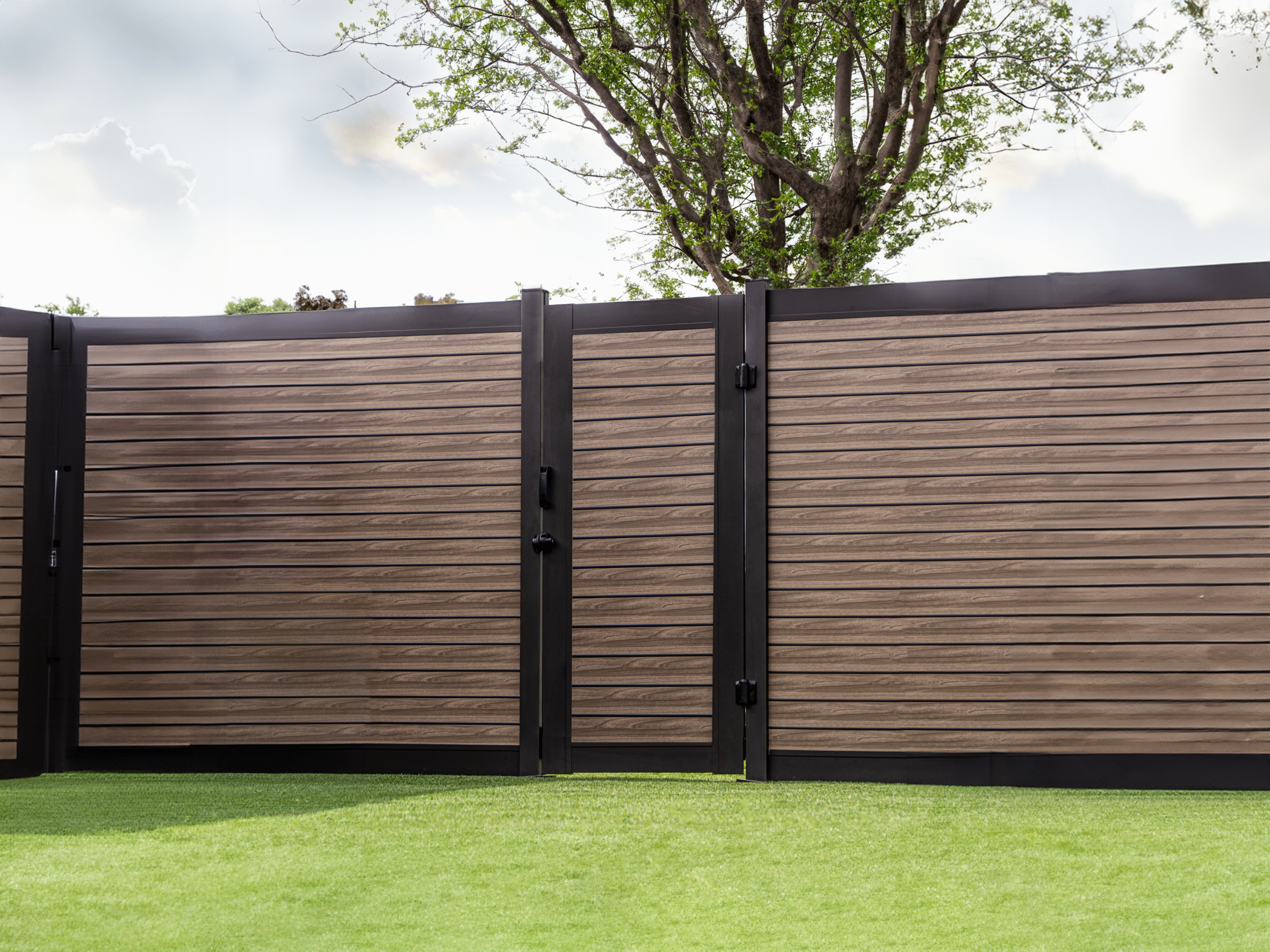
Movement Type: Swing vs Sliding (and When Each Makes Sense)
Movement type is the first decision because it constrains everything else. Swing gates need clear arc space and level approach; sliding gates need lateral run-room and a track or cantilever support. The trade-off is rarely about preference. It is about the site.
Swing Gates
Single-leaf or double-leaf gates that swing on hinges. They are the simpler mechanical option and work well on most flat or near-flat suburban driveways. A standard residential double swing covers roughly 12 to 16 feet of opening, with each leaf doing 6 to 8 feet. Beyond 8 feet per leaf, hinge load and wind load start punishing the post.
Swing gates are the wrong choice when the driveway slopes up toward the property (the gate hits grade before fully opening), when there is no landscape buffer for the swing path, or when snow regularly accumulates in the arc. In Canadian projects this last point matters: a swing gate that opens inward can be blocked for months by a single plowed snowbank.
Sliding Gates
Single-leaf gates that translate horizontally on a wheeled track or on a cantilever beam. Cantilever sliding gates are the modern default for most installs because they remove the ground track (which freezes shut, fills with debris, and requires regular cleaning).
Sliding gates need a parallel run of clear space equal to the opening width plus 1 to 2 feet of receiver pocket. They tolerate sloped driveways better than swing gates because the leaf moves laterally rather than arcing through grade. They cost more in hardware (heavier rollers, longer beam) but reduce site preparation work.
Decision Logic for Contractors
A simple rule from the field: if the driveway is flat, has clear swing-arc space, and the opening is under 14 feet, propose a swing gate. If the opening is over 14 feet, the driveway slopes, or the site has snow management concerns, propose a cantilever slide. Document the decision in the quote so the homeowner knows why the recommendation was made.
Material: Aluminum, Steel, and Wrought Iron Compared
Material selection is the second decision and it interacts with the operator selection. A heavier gate needs a stronger operator, a stronger hinge, a deeper post footing, and more conduit capacity for the higher-amp control board. Material is not just an aesthetic choice; it cascades into hardware cost.
| Material | Typical Weight (12 ft double) | Corrosion Behavior | Operator Class Needed | Best Fit |
|---|---|---|---|---|
| Aluminum | ~120 to 180 lb | Does not rust; powder coat lasts decades | Light to medium duty | Residential, light commercial, coastal sites |
| Steel | ~250 to 400 lb | Rusts at any coating breach; needs touch-up | Medium to heavy duty | Commercial, industrial, security-priority sites |
| Wrought Iron | ~280 to 450 lb | Rusts; ongoing paint maintenance required | Heavy duty | Estate properties, traditional architecture |
Why Aluminum Is the Default for Most Residential Drives
Aluminum is the practical answer for most residential driveway gates in North America for three reasons. Industry references like the Aluminum Association overview document the corrosion-resistance and weight advantages that make aluminum the favored exterior architectural metal. First, weight: an aluminum double swing weighs roughly half what a comparable steel gate weighs, which means a smaller operator, a lighter hinge, and a shallower footing. Second, finish: a quality powder-coat finish on aluminum holds color for decades without painting (the Wikipedia overview of powder coating covers the basics of how the process bonds pigment to the substrate). Third, match: when the same fence run uses aluminum panels, an aluminum gate gives the contractor finish consistency that wood or steel gates cannot.
The objection some contractors raise is structural: can aluminum take security loads? For residential perimeter applications the answer is yes, when the panel construction includes proper internal reinforcement. PrimeAlux privacy panel construction (covered in the Privacy Plus aluminum fence panel spec page and the privacy aluminum fence panel spec page) is wind-load tested to 220 km/h, which puts the wind force on a panel well above what residential gates ever see. The same construction logic applies to gate leaves built from those panels.
When Steel or Wrought Iron Wins
For commercial sites with vehicle ramming risk, security-priority installations (data centers, utility yards, high-end estates with K-rated requirements), or heritage architecture where wrought iron is the design intent, the heavier materials remain the right call. The trade-off is the maintenance schedule and the larger operator. For everything else, aluminum is the default.
Automation Tier: Manual to Fully Integrated
Automation is where most contractor margin lives, and where most warranty exposure lives too. There are four practical tiers, from least to most integrated.
Tier 1: Manual Operation
Latch and lock only. No power, no operator, no electronics. Used on lower-traffic gates, vacation properties, or when the homeowner explicitly does not want automation. Lowest install cost; lowest follow-up service.
Tier 2: Powered, Single-Channel Remote
An operator (linear actuator or articulated arm for swing; rack-and-pinion or chain drive for slide) with a basic 433 MHz or 433.92 MHz remote. Optional keypad. This is the most common residential install. Power is brought from the house panel via an underground conduit run, terminated in a weatherproof control box near the gate post.
Tier 3: Multi-Channel with Access Control
Operator plus a code keypad, RFID reader, or proximity card system. Multiple users with their own credentials. Common on small commercial sites, multi-family entrances, and short-term rental properties where the access list changes regularly.
Tier 4: Smart Integration
Operator integrated with a smart home platform (typically through a Wi-Fi or Z-Wave bridge) or a property management system. Push notifications when the gate cycles, scheduled access windows, mobile app remote opening, video doorbell tie-in. Increasingly the default ask on new builds in the $1M+ residential range.
Pro Tip on Conduit Sizing: When pulling conduit for a future-proof install, run a 1-inch PVC conduit from the gate post back to the house, even if the current spec only needs a 12-volt control line and a 120-volt operator feed. The marginal material cost is small. Adding a second pull later (for a video intercom, a fiber line, or a cellular controller upgrade) without conduit means re-trenching, which often costs more than the original gate.
Hardware: Hinges, Posts, Operators, and Safety Devices
Hinges and Pivot Points
For aluminum swing gates, heavy-duty self-closing hinges with sealed bearings are the standard. Avoid open-bearing hinges in any climate that sees freeze-thaw cycles; water enters, freezes, and the hinge seizes. Specify hinges rated for at least 1.5 times the actual gate weight, not the bare minimum. The cost difference is small and the failure mode (a sagging gate after one season) is what most homeowners notice first.
Gate Posts
The gate post is the most loaded part of the entire fence run. For aluminum driveway gates, the post should be a heavy-wall aluminum or steel-core aluminum post, set in a concrete footing below the local frost line. In most of Canada, that means an underground burial depth of 3 ft minimum. Skipping that depth is the single most common cause of gate sag complaints in the first or second winter after install.
Footing diameter for a residential gate post is typically 12 to 16 inches, depending on soil. For a heavier double swing or a sliding gate cantilever, that increases. The exact diameter is a soil and load calculation, not a guess.
Operators
Operator selection is sized to the gate weight, the duty cycle, and the climate. A residential operator rated for 25 cycles per day is undersized for a short-term rental property that may see 60 cycles. Spec to actual usage, not to nameplate. Manufacturers publish duty cycle curves; use them. Operator manufacturers that belong to the Door & Access Systems Manufacturers Association (DASMA) also publish technical data sheets covering duty cycle, motor sizing, and recommended cycles per day.
Safety Devices and Code Compliance
Automated vehicular gates are covered by ASTM F2200 (Standard Specification for Automated Vehicular Gate Construction) and UL 325 (Safety Standard for Door, Drapery, Gate, Louver, and Window Operators and Systems). The ASTM F2200 standard page describes the construction requirements. Every automated gate must include entrapment protection: typically photo-eye sensors on both sides and an inherent reverse mechanism in the operator. Skipping these devices is not a corner-cut; it is an exposure that can land on the contractor. For projects with fire performance requirements (multi-unit residential, commercial perimeters near combustible structures), the same panel construction used in the gate leaf carries the ASTM E84 Class A fire rating, which is one less variable to source separately for the spec sheet.
For Canadian sites, local electrical code (CEC) governs the conduit and connection, and any electrical work on the operator side must be done by a licensed electrician. The International Code Council resources reference applicable construction standards that may apply by reference in some Canadian jurisdictions, depending on the municipality. Always verify locally.
Installation Method: What Causes Callbacks
Most gate problems are install problems, not product problems. The five most common avoidable issues:
1. Insufficient Footing Depth
Gate posts set above the frost line move as the soil heaves. The gate is square at install and rhombic by spring. The fix is always more expensive than getting the depth right the first time. In northern climates, treat 3 ft as the floor, not the target.
2. Mismatched Operator and Gate Weight
An undersized operator runs at full duty constantly, overheats, and fails inside the warranty period. An oversized operator costs more upfront but runs cool and lasts. For a contractor, the lifetime cost of a callback is always higher than the upfront cost of a properly sized operator.
3. Power Supply Voltage Drop
A long conduit run from the panel to the gate operator can drop voltage enough to cause stuttering or motor failure. For runs over 100 feet, calculate the voltage drop and upsize the wire gauge if needed. This is basic electrical work but it is missed often enough that it shows up in industry training material.
4. No Bypass for Power Failure
An automated gate without a manual bypass traps the homeowner inside (or outside) when power is out. Every operator should have a documented manual release procedure, and the homeowner should be walked through it at handover. Document the walkthrough; it protects the contractor.
5. Finish Mismatch With the Fence Run
The gate is the most visible part of the install. If the gate is sourced separately from the fence panels, even a “matching black” finish often comes back with a slight tone or texture difference. Source the gate from the same manufacturer as the panels whenever possible. PrimeAlux aluminum gates are produced on the same coating line as the matching Privacy Plus panels and semi-privacy panels, which removes that risk for installs that use both.
Pricing Reference for Contractors
Driveway gate pricing varies widely by region, opening width, automation tier, and site conditions. As a rough planning range for residential projects in the Canadian market:
- Manual aluminum swing gate (12 ft double): the gate hardware itself is a fraction of the project; most cost lives in the posts, footings, and finish coordination.
- Powered aluminum swing with single-channel remote: add the operator, conduit, electrical, and tuning labor.
- Cantilever slide with multi-user access control: the most expensive tier; the cantilever beam, heavier post, RFID hardware, and longer conduit run all push the number up.
For a contractor, the practical advice is to quote each line item separately (gate, posts and footings, operator, electrical, controls, finish) so the homeowner sees where the cost is going. Bundled quotes invite price comparison against contractors who are cutting corners on the parts the homeowner cannot see. PrimeAlux maintains pricing references for dealers and contractors; contact the team for current dealer pricing on aluminum driveway gates and matching fence runs.
Spec Sheet Checklist Before You Quote
Before issuing a driveway gate quote, confirm the following with the client and the site:
- Opening width (rough opening and finished opening)
- Slope at the gate location (level, uphill, downhill, cross-slope)
- Existing fence panel material, color, and manufacturer (if any)
- Soil type and frost depth for the local jurisdiction
- Distance from gate to nearest electrical panel
- Required automation tier (manual, single-user remote, multi-user access, smart integration)
- Number of users and turnover rate (drives access control needs)
- Local code references (UL 325, ASTM F2200, municipal bylaws on gate height)
- Snow management plan at the gate (clearance for swing arc; clearance for slide pocket)
- Visibility and lighting requirements at the entry
A pre-quote site walk that captures these ten items prevents the most common quoting mistakes and shortens the back-and-forth with the client. It also lets the contractor source the right gate the first time, rather than ordering a swing and discovering the slope demands a slide.
Frequently Asked Questions
What is the best material for a driveway gate?
For most residential and light commercial driveways in North America, aluminum is the practical default. It is light enough to use a smaller operator, does not rust, and accepts powder-coat finishes that match aluminum fence panels. Steel and wrought iron remain appropriate for security-priority commercial sites and heritage architecture, with the trade-off of higher operator class and ongoing rust maintenance.
How deep should a driveway gate post be set?
In Canadian climates, 3 ft minimum below grade in a concrete footing is the standard for a residential gate post. The exact depth must clear the local frost line, which varies by region. Footing diameter is typically 12 to 16 inches for a residential gate, larger for double swings or cantilever slides.
What standards apply to automatic driveway gates?
The two main references are ASTM F2200 (construction requirements for automated vehicular gates) and UL 325 (safety standard for the operators that drive them). Both standards require specific entrapment protection devices, including photo-eyes and an inherent reverse function in the operator. Local electrical code (CEC in Canada) governs the wiring side.
Can a driveway gate match the rest of an aluminum fence?
Yes, when the gate is sourced from the same manufacturer as the fence panels and produced on the same coating line. This avoids the finish-tone mismatch that contractors often see when gate hardware and fence hardware come from different suppliers. PrimeAlux gates are produced on the same coating line as PrimeAlux fence panels for this reason.
How long does an automatic driveway gate installation take?
A straightforward residential install (single swing or short cantilever slide, single-user remote, conduit run already in place) is typically a 1 to 2 day install for an experienced two-person crew. Sites with new conduit pulls, complex automation, or heavy footings extend that. The site walk and pre-quote phase often takes longer than the install itself.
Do I need a separate operator brand for a sliding gate vs a swing gate?
Most major operator manufacturers produce both swing-arm and rack-and-pinion (or chain-drive) operators. Sticking with one operator brand across a contractor’s portfolio simplifies parts, training, and warranty handling. Verify the operator is rated for the actual gate weight and the actual duty cycle of the site.
What happens to the gate when the power is out?
Every UL 325 compliant operator includes a manual release that lets the gate be opened by hand during a power failure. The homeowner should be walked through this procedure at handover. Some operators also offer a battery backup module that runs the operator through short outages without the manual release.
How does aluminum perform in cold Canadian winters?
Aluminum does not become brittle in cold the way some lower-grade vinyl products do, and it does not rot or warp the way wood does after freeze-thaw cycles. The main winter consideration is snow management around the gate (clear the swing arc or the slide pocket) and operator selection rated for low-temperature operation. Operators have a published low-temperature limit; spec to the actual climate.
Next Step for Contractors and Dealers
If you are quoting an aluminum driveway gate as part of a fence project and want to confirm spec, finish match, or hardware compatibility before issuing the quote, the PrimeAlux team supports contractors and dealers with sample requests, technical drawings, and dealer pricing on the full aluminum gate line and matching privacy fence panels. For Canadian residential projects sourced through the primealux.ca aluminum gate page and the matching privacy aluminum fence line, the same product line is available with localized inventory. Contact the team to confirm current dealer pricing and lead times for your project.
