
Quick Summary for Contractors
Semi-privacy fence panels are slatted aluminum systems with intentional 10–25 mm gaps between vertical or horizontal slats. They give clients meaningful screening without the full visual mass of a solid privacy panel, and they specify well on commercial pool decks, courtyards, multi-residential separations, and any project where airflow and sightline control matter as much as privacy.
For aluminum, the practical sweet spot is a 6'x6' foam-core panel system, 3 ft underground post burial, ASTM E84 Class A fire performance, and a wind load tested to 220 km/h. PrimeAlux semi-privacy panels meet all four. This guide covers when to spec them, how to quote them, and the install details that decide whether the line item ships clean.
What Are Semi-Privacy Fence Panels (and Why Contractors Should Spec Them More Often)
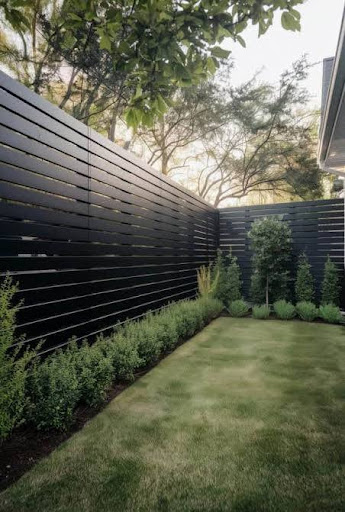
Semi-privacy fence panels are aluminum panels built with a slatted face that breaks the sightline without sealing the property off the way a solid privacy panel does. The gaps between slats sit somewhere between 10 mm and 25 mm depending on the system. From a normal viewing angle the panel reads as private; step closer or shift to an oblique angle and you get visual texture, light, and air movement.
That middle position is exactly why contractors should be spec'ing them more. Solid privacy is a strong choice for backyard pool enclosures and primary lot lines, but it isn't the right answer for every linear foot. Property edges that need wind permeability, courtyards that need diffused light, multi-residential separations between balconies, and commercial entrances all benefit from a panel that screens without acting like a wall. Semi-privacy fence panels do that job.
Aluminum is the material this category was built for. Wood semi-privacy fences crack and warp at the slat joints within a season or two. Vinyl loses rigidity in cold and warps in heat, and the slatted profile is the first place that shows. Aluminum holds its geometry, holds its finish, and holds tolerances tight enough that the gap reads consistent down the run. For installers, that consistency is what separates a clean job from a callback.
When to Specify Semi-Privacy Over Solid Privacy
The fastest way to decide is to ask what the panel needs to do besides block sightlines. If the answer involves airflow, light penetration, snow management, or aesthetic softening, semi-privacy is the right call. If the answer is pure screening, full privacy aluminum fence panels are the better fit.
Five scenarios where semi-privacy panels outperform solid privacy on a project:
- Pool perimeters with prevailing wind exposure. A solid privacy panel acts like a sail and adds load to every post. A semi-privacy panel relieves wind pressure while still satisfying most pool code visual barrier requirements.
- Courtyards and shared outdoor spaces. Diffused light reads better in shared spaces. Solid privacy creates dark zones along the wall.
- Townhome and multi-residential separations. Semi-privacy gives unit-to-unit privacy without making side yards feel boxed in.
- Slope sites with drainage concerns. Slatted panels move air across the line and reduce snow drift accumulation against the fence.
- Commercial entries and amenity spaces. Specifiers and architects increasingly want a screened look without a closed-off feel. Semi-privacy delivers that.
Worth flagging for clients: pool code in most Canadian and U.S. jurisdictions follows the framework set by the International Swimming Pool and Spa Code, which requires that any opening in a barrier within 100 mm (4") of the ground not allow a 100 mm sphere to pass. Most semi-privacy systems handle this with a solid base detail or a tighter slat spacing for the bottom course. Confirm gap dimensions against local pool code before quoting. For Canadian projects, residential aluminum semi-privacy options are also catalogued on primealux.ca semi-privacy aluminum fence for client reference.
Material Comparison: Aluminum vs Wood vs Vinyl Semi-Privacy
The slatted format punishes weak materials. Anywhere there's a gap, there's an edge that has to hold tolerance. Wood and vinyl don't hold those edges in Canadian or northern U.S. climates. Aluminum does.
| Material | Typical Lifespan | Slat Geometry Over Time | Maintenance Cost | Wind Load Behaviour |
|---|---|---|---|---|
| Aluminum (PrimeAlux) | 25+ years | Holds gap dimensions; finish stable | Zero recurring; clean as needed | Tested to 220 km/h; airflow through slats reduces sail effect |
| Cedar / pressure-treated wood | 7–12 years structural; aesthetic decline within 1–2 seasons | Slats warp, cup, twist; gaps become inconsistent fast | Stain or paint every 2–3 years; many homeowners skip it | Posts rot below grade; failure usually starts at the ground line |
| Vinyl | ~10 years before cracking and fading begin; cheap imports much sooner | Slats can warp in heat, become brittle in cold | Cleaning only, but no field repair when damaged | Shatters in sub -20°C if struck; not field repairable |
| Composite | 15–20 years | Holds shape better than wood; can swell at fasteners | Higher than aluminum on a system basis | Heavier than aluminum; post engineering matters more |
The point you're making to the client is not just "aluminum lasts longer." It's that the visual benefit of semi-privacy, the consistent slat rhythm, only holds up in aluminum. Wood and vinyl semi-privacy fences look bad fast specifically because the slat detail amplifies any warping or fading. Aluminum is the only material in this category that looks the same in year 10 as it did the day it shipped.
Panel Sizing, Slat Spacing, and Spec Decisions
Standard PrimeAlux semi-privacy panels run 4'x6' up to 8'x8', with custom sizes available on request. The 6'x6' panel is the workhorse for most residential and light commercial applications. For commercial entries and amenity walls, 8'x8' reduces post count and moves the visual rhythm into a larger module.
Three spec decisions matter on every quote:
- Slat orientation. Vertical slats are the default for screening sightlines from grade. Horizontal slats read more architectural and screen sightlines from balconies and elevated viewpoints. Both are available; the application drives the call.
- Slat profile and gap dimension. Tighter gaps (10–15 mm) approach full privacy at oblique angles. Wider gaps (20–25 mm) preserve clear airflow and lighter feel. Match this to the client's actual privacy expectation, not just "semi-privacy" as a category.
- Color/finish. Available in Natural Walnut, Grey Walnut, Walnut, Dark Walnut, and Grey Brown wood-grain finishes through a 3-layer coating process, plus standard black. Wood-grain finishes are increasingly the spec on residential and amenity projects because they read warmer than flat black.
For panels that need maximum screening in the same slatted format, look at the foam-core Privacy Plus aluminum fence panels. The foam core is what holds the panel rigid at larger sizes and damps acoustic transmission across the line.
Installation: Posts, Spacing, and the Details That Decide Callbacks
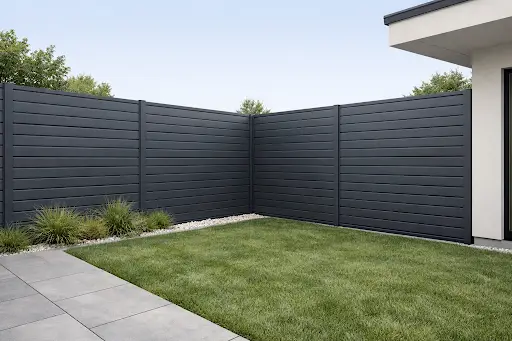
Semi-privacy panels are easier to install than solid privacy because they weigh less per panel and put less wind load on each post. That said, the slatted detail is unforgiving when it comes to plumb posts and consistent panel-to-post tolerances. Three things to get right:
1. Post burial depth: 3 ft. Below the local frost line in nearly every Canadian region per Government of Canada frost-depth references. This is the number that should be on every quote and every site instruction sheet. Cutting this depth to save concrete is the most common reason a fence leans in year three. PrimeAlux engineering specifies 3 ft as the standard burial.
2. On-center post spacing. Match the panel module exactly. For 6' panels, that's 6'-1.5" on-center to give the bracket clearance. Field measure before pouring. If posts come in tight, the panel won't seat without forcing it; if they come in long, you get sloppy bracket-to-post alignment that shows badly through the slats.
3. Concrete and footing volume. Standard residential semi-privacy spec calls for 10" diameter footings on standard posts, sized up for end posts, gate posts, and corners. Wind load tested to 220 km/h applies to the assembly, not just the panel; the footing has to hold up its share.
Pro Tip
String a temporary line at slat-top height before setting your second post on a long run. Aluminum semi-privacy panels read every degree of post lean across the slats, far more than solid panels do. A line check during the pour catches lean before the concrete sets and saves you a callback.
For the surface-mount alternative on decks, parking decks, or hardscape that can't be excavated, surface-mount post bases work but require a host structure rated for the moment load at the top of the post. Document the host structure rating in the quote. That documentation is how you avoid disputes later.
Pricing, Quoting, and Margin Notes for Contractors
Semi-privacy aluminum fence panels generally land within the same residential market range as full privacy: roughly $80–$120 per linear foot installed in the Canadian market, depending on panel height, finish, gate count, and site complexity. Contractors quoting partner systems should be pricing the line item with the same logic they use for solid privacy, not discounting because there's "less material." The engineering, the post system, the hardware, and the install labor are essentially identical.
Three margin levers worth knowing:
- Color and finish premium. Wood-grain finishes carry a small premium over flat black. Most homeowners say yes if it's presented at quoting stage; almost none ask for it after the fact.
- Gate hardware. Self-closing, self-latching gates for pool code add hardware cost. Quote these with the gate, not as a change order. Aluminum gates in matching semi-privacy slat style are available across the line, and aluminum gate options for the Canadian residential market are catalogued separately.
- Post upgrades for wind exposure. Lakefront, ridgeline, and exposed-corner sites benefit from upgraded post and footing spec. Quote it; don't absorb the engineering risk.
For a sense of how full-system aluminum pricing structures lay out across material types and exposure scenarios, the PrimeAlux Canadian privacy fence overview shows the residential market positioning.
Performance Data Worth Quoting (and What to Skip)
The case for aluminum semi-privacy holds up in performance data, but contractors should be careful which numbers they cite to clients. Verifiable third-party test data is fine and useful. Marketing claims you can't back up create disputes.
The PrimeAlux semi-privacy line has three spec points that hold up:
- Wind load: tested to 220 km/h. This is the assembly rating, panel, post, hardware, and proper footing together. It's the number to use when the client lives in a high-exposure area or when local bylaws require wind ratings.
- Fire rating: ASTM E84 Class A, Flame Spread Index 0, Smoke Developed Index 50. The ASTM E84 fire test data is published. This matters for properties in wildland-urban interface zones, around BBQ patios, and on multi-residential projects where assembly fire behaviour gets reviewed.
- Recycled content: up to 70% recycled aluminum. Useful on commercial projects pursuing LEED certification, Green Globes, or local sustainability incentives.
Things not to claim without confirmation: specific warranty durations, acoustic STC ratings, or test results outside the published set. If a client or specifier asks for documentation beyond the above, flag it as "available upon request" and route through PrimeAlux for the actual reports.
Industry context worth keeping in mind: a number of fence suppliers publish wind ratings with no backing test data. ASTM E84 and a 220 km/h tested rating are easy to verify, and that verifiability is itself a selling point against competitors who can't produce reports. The U.S. ASTM E84 standard documentation is publicly available and worth referencing in commercial bids.
Common Spec Mistakes to Avoid
Patterns that come up repeatedly when contractors are new to semi-privacy aluminum:
- Mixing slat orientations within the same run. Looks fine on a render; reads chaotic in the field. Pick one orientation per run.
- Underspeccing posts on long runs. The lighter wind load doesn't mean lighter posts. Stick to engineered spec for end and corner posts especially.
- Forgetting the bottom-gap detail. Pool code, animal containment, and curb-appeal all care about the last 100 mm to grade. Order the right starter detail with the panel; don't improvise it on site.
- Quoting without site photos. Slope, soil type, and overhead utilities all change the post job. Photo-based quotes for semi-privacy are tighter than for solid privacy because the eye sees post irregularities through the slats.
- Pricing too cheap to win the bid. Aluminum semi-privacy is a premium category, and clients who shop on price alone usually end up replacing it with wood or vinyl that fails fast. The right buyer cares about lifespan and finish stability.
Frequently Asked Questions
What is the difference between privacy fence panels and semi-privacy fence panels?
Privacy fence panels block all sightlines and airflow. Semi-privacy fence panels use slatted construction with intentional gaps (typically 10–25 mm) so the panel screens views at normal angles but still allows light and air through. Privacy is the right pick when complete screening is the priority; semi-privacy is the right pick when airflow, light, or aesthetic softening matter alongside privacy.
How deep should aluminum fence posts be set for semi-privacy panels?
Standard PrimeAlux engineering calls for 3 ft of underground burial on aluminum fence posts. This depth places the footing below frost line in nearly every Canadian region and supports the assembly's 220 km/h wind rating. Cutting this depth to save concrete is the single most common cause of leaning aluminum fences.
Can semi-privacy fence panels be used around pools?
Yes, and they often perform better than solid privacy panels in pool applications because they reduce wind load on the assembly. Confirm bottom-gap and overall height against local pool code before ordering. Most jurisdictions require that no opening within 100 mm of grade allow a 100 mm sphere to pass, which usually requires a solid base detail or tighter slat spacing for the bottom course.
Are semi-privacy aluminum fence panels available in wood-grain finishes?
Yes. PrimeAlux semi-privacy panels are available in Natural Walnut, Grey Walnut, Walnut, Dark Walnut, and Grey Brown wood-grain finishes through a 3-layer coating process, in addition to standard black. The wood-grain finish is increasingly common on residential and amenity projects because it reads warmer than flat black.
How much do semi-privacy aluminum fence panels cost installed?
Pricing in the Canadian residential market generally runs $80–$120 per linear foot installed, depending on height, finish, gate count, and site complexity. Quoting should match the logic used for solid privacy aluminum because the engineering, posts, hardware, and labor are similar.
What wind load can PrimeAlux semi-privacy panels handle?
The PrimeAlux assembly is tested to 220 km/h. That rating applies to the full assembly: panel, post, hardware, and correct footing. Quoting based on this rating requires installing to spec, including 3 ft post burial and properly sized footings.
Are these panels rated for fire performance?
Yes. PrimeAlux aluminum panels carry an ASTM E84 Class A rating with Flame Spread Index 0 and Smoke Developed Index 50. This matters in wildfire interface zones, around outdoor kitchens, and on multi-residential and commercial projects where assembly fire behaviour is reviewed.
What slat spacing should I specify for a semi-privacy fence?
Tighter gaps in the 10–15 mm range read close to full privacy at oblique viewing angles and are common on residential side yards. Wider gaps in the 20–25 mm range preserve more airflow and feel lighter, which suits courtyards and amenity spaces. Match the spec to the privacy expectation the client described, not just the category name.
Quoting Semi-Privacy with Confidence
Semi-privacy aluminum fence panels deserve more weight in contractor product mixes. They solve a real client problem that solid privacy doesn't: screening without sealing. And they're one of the few panel categories where aluminum is the only material that holds up long term. The spec decisions are straightforward once you know the right questions to ask: orientation, gap dimension, post burial, finish.
For dealer pricing, project quoting, install instruction sheets, or technical data on specific configurations, contact PrimeAlux directly. Available test reports and BOM documentation are released on request through the dealer channel. To start a quote or request the contractor pricing book, see the PrimeAlux semi-privacy aluminum fence systems page, browse the contractor blog for related installation and spec articles, or get in touch through the PrimeAlux contact channels.
