
Quick Summary
A surface mount fence post bolts to an existing concrete slab, deck, or footing using a base plate, while an in-ground post is buried in a concrete-filled hole at least 3 ft deep. Surface mounts are faster to install and work well on finished concrete, raised patios, and commercial pads. In-ground posts carry higher lateral loads and remain the right call for residential property lines, privacy fencing, and anywhere wind exposure is high. A contractor who knows when to specify each method saves labour hours, reduces callbacks, and avoids the most common reason aluminum fences lean: the wrong post anchoring method for the substrate.
What is the difference between a surface mount fence post and an in-ground fence post?
A surface mount fence post is anchored on top of an existing hard surface using a pre-welded base plate, four anchor bolts, and either wedge anchors, epoxy anchors, or through-bolts depending on the substrate. An in-ground fence post is buried in a hole backfilled with concrete, with the post itself extending below frost depth to resist lateral load and frost heave.
The two methods solve the same problem, keeping a fence post vertical under wind, impact, and soil movement, but they solve it in very different ways. Surface mounts rely on the mass and rigidity of the substrate below them. In-ground posts rely on the cone of concrete around them and the passive resistance of the surrounding soil. Neither is universally better. The right choice depends on the substrate, the wind load on the panel, the aesthetic requirement, and the cost constraints of the job.
For privacy aluminum fence panels, the sail area of each panel is large, which means wind load on the post is significant. Contractors specifying privacy systems should lean toward in-ground posts unless the substrate is a properly engineered concrete pad. For semi-privacy systems, where the panels have open space between slats and wind passes through more easily, surface mounts become a realistic option on a wider range of substrates.
When should contractors specify a surface mount fence post?
Surface mount posts are the right choice when the project has an existing concrete pad, deck structure, rooftop, or pool surround that you cannot or should not cut into. They are also preferred on commercial jobs where speed of installation and finished-site cleanliness drive the schedule.
The specific conditions where a surface mount is the better call:
- Finished concrete pads of adequate thickness (typically 4 inches minimum for light loads, 6 inches for privacy panels with higher wind exposure).
- Rooftop terraces and parapet edges where you cannot dig.
- Existing commercial slabs around loading docks, patios, or pool decks where the concrete was engineered for point loads.
- Raised decks and balconies using through-bolts into framing members or blocking.
- Short-run installations such as gate side posts at a driveway entrance, where in-ground footings would slow the schedule for one or two posts.
- Sites with utilities running close to the surface where excavation is risky.
The weakness of surface-mounted posts shows up when the substrate cannot resist the moment load. A 6 ft x 6 ft privacy panel in a 100 km/h gust generates significant torque at the base. If that base is resting on a 3 inch pad with no reinforcement, the pad cracks before the anchors fail. Always verify the substrate specification before quoting a surface-mount installation.
When should contractors specify in-ground posts?
In-ground installation is the default for residential property line fences, any run longer than 20 ft, any site with soft soil, and any project where wind exposure is the limiting factor. The concrete footing and the surrounding soil act together to resist lateral load, and there is no substrate to crack or spall.
Key scenarios where in-ground is correct:
- Residential property line fencing where the yard is open turf or garden bed.
- Privacy fence runs that extend more than 20 ft, where wind load accumulates and every post needs to resist it equally.
- Sites in wind-exposed areas, including lake frontage, open prairie, and hilltop lots.
- Ground with frost cycles, where the footing must extend below the local frost line (3 ft below grade in most of Canada, deeper in northern zones).
- Slopes where racked panels transfer asymmetric loads to the posts.
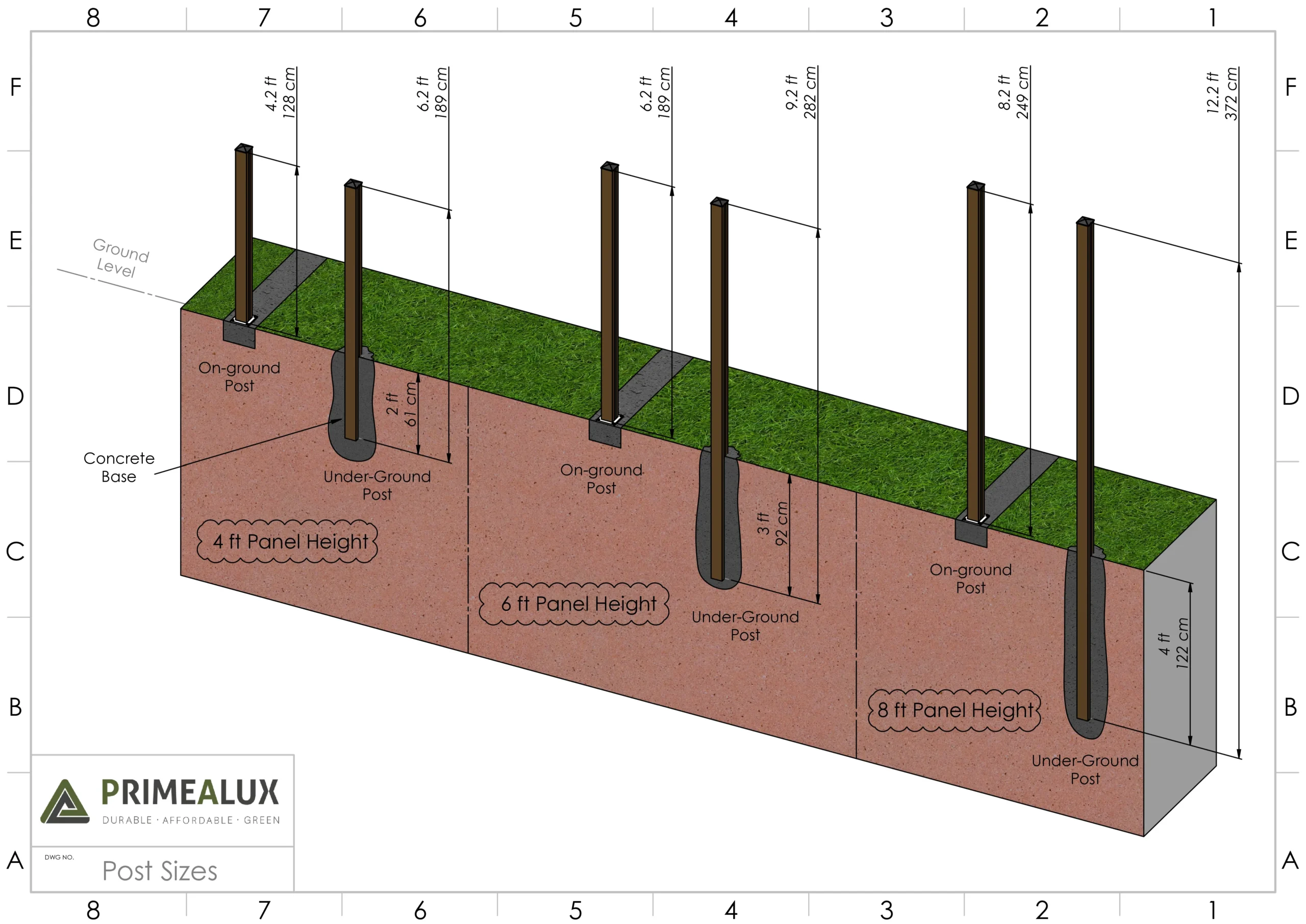
In-ground aluminum posts from a quality manufacturer such as PrimeAlux are pre-cut with an underground section designed to carry the footing load. The post depth below grade for PrimeAlux systems is 3 ft, which places the footing below typical Canadian frost depth and provides enough embedment to resist the lateral moment from a fully glazed privacy panel.
How the two methods transfer load differently
Understanding the load path is what separates a contractor who installs fences reliably from one who has to come back on the first windy weekend to straighten posts.
A surface mount post converts wind load into tension on the anchor bolts at the back of the base plate, compression on the front edge of the plate, and shear across the fasteners. The concrete slab has to be thick enough and well-reinforced enough to resist cracking around the anchors. Anchors spaced too close to the slab edge will break a concrete cone out the side under load, which is why base plates typically need at least 4 inches of edge distance in any direction.
An in-ground post converts wind load into a moment at the ground surface, which is resisted by lateral compression against the concrete footing and the surrounding soil. The deeper the footing, the smaller the effective lever arm and the less lateral stress any given soil fiber has to carry. This is why frost-depth burial is a load consideration as well as a frost-heave consideration.
Pro Tip
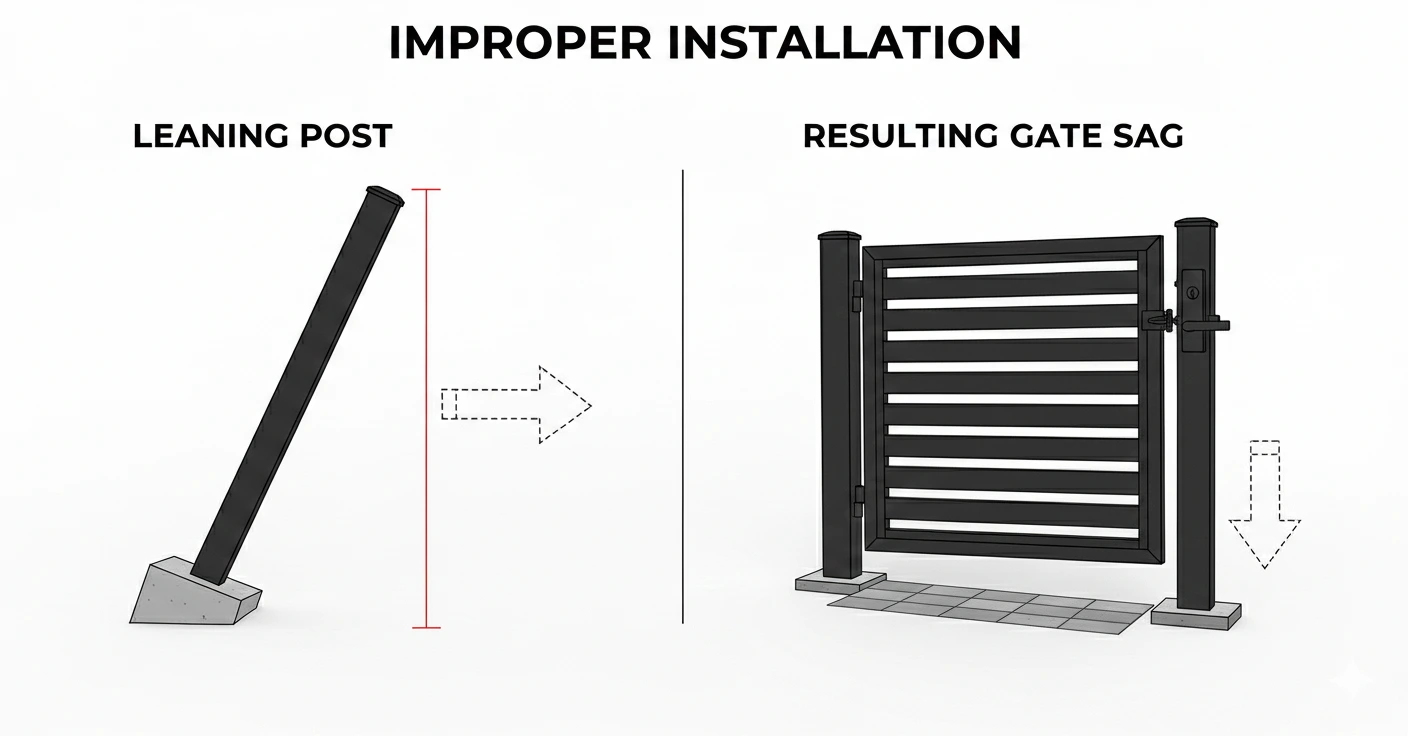
If a customer calls back about a leaning fence, diagnose the anchoring before diagnosing the post. An aluminum post rated to 220 km/h wind load will sit at a 15-degree angle not because the post failed, but because the footing moved or the slab cracked. Replacing the post without correcting the anchoring only buys another season.
Method comparison: surface mount vs in-ground at a glance
The table below summarizes the practical trade-offs most contractors weigh when quoting a fence project. It covers installation time, substrate requirements, typical cost delta, and performance under load.
| Factor | Surface Mount | In-Ground (3 ft concrete footing) |
|---|---|---|
| Install time per post | 10 to 20 minutes once substrate is prepped | 30 to 60 minutes including concrete set |
| Substrate requirement | Concrete, deck framing, or engineered pad | Any soil that holds a concrete pour |
| Typical material cost | Higher per-post (base plate, anchors) | Lower per-post (bag of concrete only) |
| Typical labour cost | Lower (no digging, no concrete mixing) | Higher (digging, mixing, staging) |
| Lateral load capacity | Limited by substrate and anchor edge distance | High; governed by footing diameter and depth |
| Frost heave risk | N/A if substrate is frost-protected | Low if footing reaches 3 ft depth |
| Best for | Commercial slabs, decks, pool surrounds, short runs | Residential yards, long privacy runs, wind-exposed sites |
| Rework difficulty if misaligned | Moderate (redrill anchors) | High (break out footing) |
Hardware and fastener selection for surface-mount aluminum posts
Surface mount installation lives or dies on the fasteners. The post itself can be rated to any wind load, but if the anchors do not hold, the rating does not matter. Contractors should specify hardware based on three factors: substrate type, exposure (interior, exterior, coastal), and the edge distance available on the slab.
- Wedge anchors (3/8 inch or 1/2 inch) are the most common fastener on cured concrete. Use stainless steel in any installation within 10 km of salt water or where road salt will reach the base.
- Adhesive (epoxy) anchors outperform wedge anchors when edge distance is tight, because the load spreads through the bond line instead of relying on the anchor expanding against the concrete.
- Through-bolts with backing plates are the right call on wood decks, where the base plate is bolted through the decking into a blocked joist below. A backing plate distributes the load and prevents the bolt head from crushing into the wood.
- Lock nuts or thread-lock compound should be used on all anchor bolts exposed to vibration or cyclic wind load. Plain nylock nuts or a drop of threadlocker is the difference between a fence that stays tight for years and one that needs a torque check every spring.

For reference, the American Concrete Institute publishes edge-distance and embedment requirements for cast-in and post-installed anchors in ACI 318 Chapter 17. Contractors working on commercial or engineered projects should verify that the anchor pattern and substrate meet those requirements before pouring or drilling.
In-ground installation: concrete footing sizing and depth
A correct in-ground installation is a small engineering problem. The footing must be deep enough to sit below frost, wide enough to resist the lateral moment from the panel, and set with the right concrete mix for the soil and weather conditions.
PrimeAlux systems are designed around a 3 ft underground post section set in a concrete footing at least 10 inches in diameter for standard 6 ft x 6 ft panels. Wider panels, taller panels, or windier exposures call for larger footings. Contractors should scale the footing diameter with panel size and site exposure rather than using a one-size-fits-all detail.
Key practices for a reliable in-ground installation:
- Dig to frost depth plus a safety margin. Most of southern Canada sits at 3 ft to 4 ft frost depth. Northern Ontario, the Prairies, and the interior of BC need deeper footings. Confirm the local frost penetration value against CSA A23.1 and the regional building code rather than assuming.
- Use a bell-bottom footing in soft soil. Flaring the bottom of the hole adds uplift resistance and reduces lateral deflection.
- Crown the top of the footing above grade. A slight crown sheds water away from the post base and prevents the footing from sitting in a puddle that freezes and lifts.
- Let the concrete set before loading the panel. Fast-set mixes reach usable strength in 1 to 2 hours, but standard Portland mixes need 24 hours before panels are pinned in.
- Verify plumb twice. Once at set, then again the next morning before the panel goes on. Concrete can shift as it cures.
For taller gate posts or primary structural posts at the end of a run, reference the installation manuals supplied with PrimeAlux aluminum gates, which include engineered depth and diameter specifications for the gate post footing.
Wind load and the post anchoring method
Wind is the single largest load on a fence post under normal service conditions. A properly anchored post resists it. A poorly anchored post telegraphs wind load into the footing, the slab, or the fasteners, and something eventually gives.
PrimeAlux aluminum fence systems are wind-load tested to 220 km/h, which is at or above Category 4 hurricane speeds. That rating is for the panel and post assembly. The achievable rating on any given site is always limited by the anchoring method. A surface mount in a 4 inch slab will never see 220 km/h capacity regardless of the post rating. An in-ground post in a 3 ft concrete footing in normal soil is the anchoring method that lets the system approach its rated capacity.
For commercial or coastal work where design wind speeds are high, contractors should:
- Specify in-ground installation wherever the substrate allows it.
- Increase footing depth or diameter beyond the standard detail in exposed locations.
- Reference National Building Code of Canada wind exposure categories before specifying post spacing and footing size.
- Confirm that the full assembly is aluminum, since dissimilar metal fasteners accelerate corrosion in high-humidity or salt environments. For deeper background on galvanic considerations, the ASTM International B117 salt-spray standard is the reference most manufacturers use to validate their coating and hardware systems.
Cross-reference the ASTM E84 fire performance data if the project also has fire-code exposure requirements, which is common in multi-unit residential, commercial patios, and parking-adjacent perimeter fencing.
Common installation mistakes on both methods
Across both mounting methods, the same small mistakes cause the majority of service calls. A short checklist for contractors and installation crews:
- Shallow in-ground footings. Setting a post at anything less than 3 ft because the ground is hard is the single most common cause of leaning posts in Canadian installations. Stick to 3 ft as the minimum, always.
- Surface-mount anchors too close to slab edges. Wedge anchors need at least 4 inches of edge distance in most slabs. Closer than that, the concrete cone breaks out under load.
- Mixing metals without isolation. Zinc-plated or galvanized fasteners on aluminum posts in damp ground accelerate galvanic corrosion. Use stainless steel or aluminum fasteners, or isolate with a non-conductive sleeve.
- Skipping torque verification. Every post on a commercial job should have its anchor bolts torqued to spec and rechecked after the first season. A five-minute torque check prevents most two-hour callbacks.
- No weep path at the post base. Water that enters the top of a hollow post has to exit somewhere. If the base is sealed, the post holds water, freezes, and splits the coating at the ground line.
- Ignoring soil type. Expansive clay heaves very differently from sandy loam. Footing diameter should grow in expansive soil to resist frost jacking.
For a broader view of why aluminum outperforms other materials in outdoor applications, the PrimeAlux privacy fence page covers how the system was engineered to resist the failure modes seen in wood and vinyl fences, which are often the fences being replaced.
Quoting and pricing: how to price each method for homeowners and property managers
Pricing a fence project is where the decision between surface mount and in-ground becomes a business question as well as a technical one. For residential projects, the installed price range for an aluminum privacy fence in Canada sits roughly between $80 and $120 per linear foot, depending on height, panel style, and terrain.
Two pricing principles for contractors:
- Do not price surface-mount as a discount option. Surface mounts look faster on paper, but they carry hardware costs and substrate risk that an in-ground footing does not. Price them at parity or above, and explain the trade-off to the customer.
- Include a substrate assessment fee in commercial quotes. If the customer is asking for surface mounts on an existing pad, the pad needs to be measured, cored if necessary, and verified against the anchor specification. That is billable work.
For distributors and dealer partners who sell PrimeAlux systems, the Privacy Plus panel line and semi-privacy line both support surface-mount and in-ground configurations. Matching the right panel to the right anchoring method is what separates a clean install from a callback.
FAQ: Surface Mount vs In-Ground Fence Posts
Can you use surface-mount fence posts on asphalt?
Asphalt is not a suitable substrate for surface-mount fence posts. It flexes under temperature cycling and compresses under point load, which lets the anchors work loose. Use in-ground installation with a concrete footing that passes through the asphalt layer and into the base material below.
How deep should a fence post be buried in Canada?
3 ft is the minimum for most of Canada. This places the footing below typical frost depth in southern Ontario, Quebec, and the Maritimes, and provides enough embedment to resist the lateral load from a fully glazed privacy panel. Northern zones with deeper frost require deeper footings.
Do surface-mount posts need to be engineered?
For residential work on a code-compliant concrete slab at least 4 inches thick, standard details from the manufacturer are typically acceptable. For commercial, rooftop, or pool deck work, an engineer’s stamp is often required to verify anchor capacity against the design wind load and substrate condition.
What is the best fastener for surface-mount aluminum fence posts?
3/8 inch stainless steel wedge anchors or adhesive anchors are the industry standard for cured concrete. On wood decks, use through-bolts with a stainless backing plate. Always match the fastener material to the exposure environment. Stainless outperforms galvanized in any location where salt air or road salt is a factor.
Can you convert a surface-mount post to an in-ground post later?
Yes, but it is not a quick job. The base plate must be cut off, the slab cored, the post lowered into a new footing, and the concrete patched. It is cheaper to specify the right method the first time. When a conversion is unavoidable, plan for a full-day rework per post.
Are surface-mount posts code compliant for pool safety fences?
Surface-mount installation is allowed in most Canadian municipalities for pool safety fencing, provided the substrate and the anchor spec meet the local pool enclosure bylaw and the gate hardware complies with the self-closing and self-latching requirements. Always confirm with the local building department before quoting.
What causes an in-ground aluminum fence post to lean over time?
The two main causes are a footing that is too shallow (below the 3 ft minimum) and a footing that is too narrow for the panel’s wind exposure. A third, less obvious cause is water pooling at the post base, which freezes and lifts the footing out of position over several winters. Correct drainage around the base prevents this.
Does PrimeAlux supply both surface-mount and in-ground post options?
Yes. PrimeAlux aluminum fence systems are available with both surface-mount base plates and in-ground post sections. Panel sizes run from 4 ft by 6 ft up to 8 ft by 8 ft with custom sizing available on request. Contact PrimeAlux directly for anchoring hardware options and substrate-specific detail drawings.
Choose the method that matches the job, not the habit
Every installer has a preferred method. That preference is useful as a starting point, but not as a universal rule. The job in front of you has a specific substrate, a specific wind exposure, and a specific aesthetic goal, and the post anchoring method should follow from those inputs, not from muscle memory.
A clean decision tree: if the substrate is finished concrete on an engineered pad and the panel is semi-privacy or shorter than 6 ft, surface mount. If the substrate is open yard, the panel is privacy or 6 ft and taller, or the site is wind-exposed, in-ground at 3 ft minimum. Anywhere in between, weigh the cost and risk carefully and document the decision on the quote.
Contractors, dealers, and distributors who want a full spec sheet, substrate-specific detail drawings, or wholesale pricing on aluminum fence systems can contact PrimeAlux directly. The PrimeAlux technical blog publishes installation guidance for contractors regularly, and product pages including the Privacy panel li
