
Horizontal fence panels have moved from a niche design choice to one of the most requested fence styles across Canadian residential and commercial projects. Clients who once defaulted to vertical slat privacy fencing are now arriving at contractor meetings with inspiration photos featuring clean, board-form horizontal lines. If you are specifying, supplying, or installing residential and commercial fencing, understanding the horizontal panel market positions your business ahead of the requests already coming in.
This guide covers what drives the horizontal style trend, how aluminum horizontal panels compare to wood alternatives, how PrimeAlux Privacy Plus addresses contractor-specific needs, and what installation details to communicate to clients before the job starts.
What Are Horizontal Fence Panels and Why Are Clients Requesting Them?
Horizontal fence panels orient their slats or boards parallel to the ground rather than vertical. This produces a contemporary, architectural look that reads as a deliberate design choice rather than a standard fence installation. Demand for horizontal fence styles has grown consistently in Canada over the past five years, driven by modern home design trends that favour clean lines, board-and-batten exteriors, and cohesive indoor-to-outdoor aesthetics.
According to the Canada Mortgage and Housing Corporation, spending on residential exterior upgrades reached record levels in the post-pandemic period as homeowners redirected renovation budgets toward outdoor living improvements. Fencing became a visible marker of a high-end outdoor project. Horizontal panels, with their architectural quality, became the fence style that premium residential clients and landscape designers sought out.
For contractors, the practical implication is significant: clients requesting horizontal panels typically arrive with a defined vision, a larger project budget, and an expectation of quality that extends from materials to installation precision. They are comparing your quote against landscape architects and premium fence suppliers, not the lowest-cost option at the nearest hardware store.
Horizontal Fence Panels: Aluminum vs Wood
Horizontal wood fence panels present a particular durability problem that contractors should communicate upfront. Wood boards laid horizontally are more exposed to standing water at the top edge of each slat than vertical boards, which accelerates the rotting, warping, and graying that wood fencing already suffers in Canadian climates. A horizontal cedar fence that looks sharp in year one can begin showing visible warping by year two or three, especially in high-moisture regions or shaded yards where boards stay wet longer.
Aluminum horizontal fence panels do not share this failure mode. Aluminum does not absorb moisture, which means the horizontal orientation carries no structural penalty compared to a vertical aluminum install. The Privacy Plus panel system from PrimeAlux adds a polyurethane foam core to the horizontal slat construction, increasing rigidity and acoustic performance without the weight or moisture-retention issues that affect wood boards.
| Feature | Horizontal Cedar | Horizontal Aluminum (Privacy Plus) |
|---|---|---|
| Typical lifespan | 8–12 years structural | 25+ years |
| Appearance at Year 3 | Graying, cracking likely | Unchanged |
| Maintenance | Stain or seal every 2–3 years | Occasional cleaning only |
| Wind resistance | No certified rating | Tested to 220 km/h |
| Fire rating | Combustible, no rating | Class A, ASTM E84 (FSI 0) |
| Moisture response | Warps, rots at joints | Unaffected |
| Recycled content | None | Up to 70% recycled aluminum |
| Weight | Heavy, difficult to handle solo | Lightweight, faster to install |
The maintenance story is the one most relevant to your clients. A wood horizontal fence will require staining every two to three years, and most homeowners stop doing it after the first cycle. Within five years, a horizontal cedar fence that started as a premium feature becomes a visible liability on the property. Aluminum holds its finish and form without any of that intervention.
Privacy Plus System: Specs and Features Contractors Need
The PrimeAlux Privacy Plus line is the horizontal panel system in the PrimeAlux product range. Here are the specifications relevant for quoting and specification work:
- Panel sizes: 4′×6′ up to 8′×8′, with custom sizes available
- Slat orientation: Horizontal, continuous run
- Core construction: Polyurethane foam-core (adds rigidity and acoustic performance)
- Coating system: Three-layer wood-grain finish (powder base coat, colour coat, clear protective topcoat)
- Available finishes: Natural Walnut, Grey Walnut, Walnut, Dark Walnut, Grey Brown
- Post burial depth: 3 feet minimum for Canadian climates
- Wind load rating: Tested to 220 km/h
- Fire rating: Class A, ASTM E84: Flame Spread Index 0, Smoke Developed Index 50
- Recycled aluminum content: Up to 70%
The Class A fire rating under ASTM E84 is worth highlighting for commercial projects specifically. Many commercial building permits and specs require fire-rated materials for exterior cladding and screening. Having documented test data on file eliminates a procurement hurdle that trips up competitors using unrated products. The full fire test report is available on the PrimeAlux ASTM E84 test page.
The three-layer coating process produces a finish that does not fade, chalk, or peel under normal Canadian conditions. The wood-grain textures, Walnut variants and Grey Brown, make the aluminum panels read as natural wood from a distance, which is a selling point for clients who want the horizontal wood aesthetic without wood’s maintenance obligations.
Installation Considerations for Horizontal Aluminum Panel Systems
Horizontal fence panels create a few installation conditions that contractors should account for during site assessment and project quoting. Getting these right on the front end avoids callbacks and scope creep after the job starts.
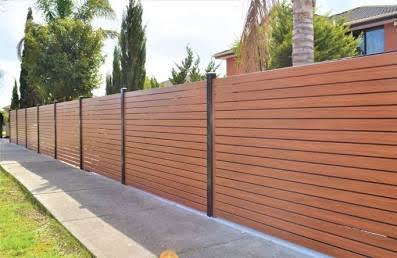
Post alignment matters more than with vertical systems. Horizontal panels are visually sensitive to post height and spacing in a way vertical slat fencing is not. Any deviation in post height reads immediately in the horizontal lines, particularly noticeable on long runs. Careful layout and level-checking before concrete sets is non-negotiable. Allocate additional layout time on horizontal installs compared to a standard vertical panel job.
Sloped sites require stepped installation, not racking. Horizontal systems cannot be racked the way standard aluminum panel systems can. On sloped sites, the panels need to be stepped, each panel section drops in elevation to follow the grade, with the step increments aligned to panel width for a clean visual result. Factor additional labour time for any sloped site, typically 15–25% above the flat-site equivalent depending on grade severity.
Gate alignment is critical on horizontal jobs. Clients who specify horizontal panels are usually detail-oriented about the final look. A gate frame that sits even slightly out of alignment with the panel horizontal lines will stand out. PrimeAlux aluminum gates are designed to match the Privacy Plus panel system. Confirm gate hardware requirements at the quoting stage, including self-closing and self-latching specifications if the installation is a pool enclosure.
Cut ends need finishing consideration. On installations that require field-cutting, cut ends of aluminum panels should be treated or capped to maintain a clean appearance. Unlike wood, aluminum does not absorb moisture at cut ends, but visible raw cuts can affect the finished look on high-end residential jobs where clients are paying attention to every detail.
Commercial Applications for Horizontal Aluminum Fence Panels
Horizontal aluminum fence panels serve a range of commercial applications where the combination of contemporary aesthetics and certified performance specs is commercially valuable. According to Grand View Research, the global aluminum fencing market is growing as commercial property developers and institutional clients shift toward low-maintenance, long-lifecycle materials for exterior applications. Horizontal panels occupy the premium segment of that market.
Common commercial applications include:
- Multi-unit residential: Horizontal panels for condo amenity areas, rooftop patios, and ground-level privacy screening where the building’s design language carries through to exterior features
- Retail and hospitality: Restaurant patios, hotel pool screening, and retail outdoor displays where brand aesthetic and material quality are part of the client experience
- Corporate campuses and institutional: Outdoor break areas and perimeter screening where fire ratings are frequently specified and wind load documentation is required for permit submission
- Townhome developments: Developers seeking a consistent, premium fence specification across a multi-unit project without the maintenance liability of a wood product
The ASTM E84 Class A fire certification and 220 km/h wind load test data make Privacy Plus panels specification-ready for commercial jobs where product documentation is part of the permitting process. Homeowners in the Canadian residential market can also access Privacy Plus directly, making it a product with demand across both client types you likely serve.
Horizontal vs Other Modern Privacy Fence Options
Contractors sometimes ask how horizontal panels compare to other contemporary fence styles clients may be researching. Two common comparisons come up:
Horizontal panels vs. semi-privacy vertical slat systems: A semi-privacy panel in vertical orientation has spaced slats that allow airflow and partial light transmission while reducing visual privacy. Horizontal full-privacy panels provide complete visual privacy in a horizontal format. They are not functionally interchangeable, both address privacy, but with different visual outcomes. Clients who specifically want the horizontal look require the horizontal panel system; vertical alternatives will not satisfy the aesthetic they are specifying.
Horizontal aluminum vs. horizontal composite panels: Composite fence boards have entered the horizontal fence market as a wood-alternative option. However, composite products remain vulnerable to UV fading, thermal expansion in summer heat, and brittleness in cold Canadian winters. Aluminum panels are unaffected by these conditions. The Privacy Plus foam-core construction also provides acoustic performance that solid composite boards do not offer. The 10-year lifecycle advantage of aluminum over composite translates to a measurable long-term cost benefit for clients thinking about total cost of ownership rather than purchase price alone.
| Style Option | Privacy Level | Maintenance | Commercial Rating Available |
|---|---|---|---|
| Horizontal aluminum (Privacy Plus) | Full | None | Yes (ASTM E84 Class A) |
| Vertical privacy panel | Full | None | Yes (ASTM E84 Class A) |
| Vertical semi-privacy | Partial | None | Yes |
| Horizontal cedar | Full | High: stain every 2–3 years | No |
| Horizontal composite | Full | Moderate (UV and heat damage over time) | No |
Frequently Asked Questions About Horizontal Fence Panels
Are horizontal fence panels more expensive to install than vertical?
Horizontal aluminum fence panels cost roughly the same to install as vertical systems on flat sites. On sloped terrain, horizontal systems require stepped installation rather than racking, which adds labour time, budget an additional 15–25% for labour on sloped sites. Material costs are comparable between horizontal and vertical aluminum panel systems within the same product line.
Do horizontal aluminum fence panels warp or sag over time?
No. Aluminum horizontal fence panels do not warp, sag, or rot. Aluminum is not affected by moisture, so the horizontal orientation carries no structural penalty. The foam-core construction in Privacy Plus panels adds rigidity across the panel face. Wood horizontal boards, by contrast, are prone to warping as moisture collects at the top edge of each board, a failure mode that accelerates over Canadian winters.
What post depth is required for horizontal aluminum fence panels?
PrimeAlux aluminum fence posts should be buried a minimum of 3 feet deep in Canadian climates. This depth accounts for the frost line in most Canadian provinces and provides the anchoring needed for the system’s 220 km/h wind load rating. Shallower installs risk frost heave and post movement, which is particularly visible in a horizontal panel system where misalignment reads clearly.
Can horizontal fence panels be used for pool enclosures in Canada?
Yes, aluminum horizontal fence panels can be used for pool enclosures. The gate hardware must meet provincial requirements for pool fence compliance, typically self-closing and self-latching mechanisms. PrimeAlux aluminum gates are compatible with compliant pool fence hardware. Confirm province-specific height requirements during the site assessment phase.
What finishes are available for horizontal aluminum fence panels?
PrimeAlux Privacy Plus horizontal panels come in five wood-grain finishes: Natural Walnut, Grey Walnut, Walnut, Dark Walnut, and Grey Brown. All finishes use a three-layer coating process that does not require painting, staining, or sealing. The finish is applied to the aluminum substrate before panel assembly and is resistant to UV fading, moisture, and temperature cycling.
How do horizontal fence panels handle sloped properties?
Horizontal fence panels on sloped sites require a stepped installation rather than a racked one. Each panel section is installed level, with the panels dropping in elevation at intervals that follow the grade. Step heights are typically matched to panel width increments for a clean visual transition. This is a different site-planning conversation than a racked vertical panel install and should be addressed at the quoting stage.
Are horizontal aluminum fence panels fire-rated?
Yes. PrimeAlux Privacy Plus horizontal fence panels carry a Class A fire rating under ASTM E84, with a Flame Spread Index of 0 and a Smoke Developed Index of 50. This is the highest fire-resistance classification under this standard. The test documentation is available through PrimeAlux for commercial projects where material certification is required for permit submission.
What is the difference between the Privacy and Privacy Plus lines for horizontal panels?
Privacy Plus is the horizontal foam-core system; the standard Privacy line uses a vertical slat configuration. Both deliver full visual privacy, but Privacy Plus adds acoustic performance through foam-core construction and a horizontal orientation. For clients specifically requesting horizontal fencing, Privacy Plus is the relevant product. Contact PrimeAlux to discuss panel sizing, finish options, or custom configurations.
Horizontal Fence Panels: What the Trend Means for Your Business
Horizontal fence panels are not a transitional style. The preference for clean horizontal lines reflects a broader architectural direction in Canadian residential and commercial construction that has proven consistent over the past decade. Clients will keep asking for it.
For contractors and dealers, the question is whether your product line can actually deliver a horizontal option that holds up through the first winter, the second season, and the decade after that. A wood horizontal install that starts warping and greying within two years is a visible failure tied to your business name. An aluminum system that looks the same five years after installation is a visible referral.
The PrimeAlux Privacy Plus system is built around the performance specs contractors need to sell confidently: documented fire rating, verified wind load, foam-core rigidity, and a coating system that maintains appearance without maintenance demands. For product information, sample requests, or dealer pricing, visit primealux.com or primealux.ca for the Canadian residential market.