
Commercial properties deal with higher foot traffic, stricter building codes, and tighter maintenance budgets than residential jobs. Aluminum fencing handles all of that, which explains why it keeps taking market share in the $10.6 billion North American fencing industry (Grand View Research, 2024). Here is what contractors, property managers, and specifiers should know before choosing a commercial aluminum fence system.
Multi-unit residential, retail, hospitality, industrial: every property type has different demands on a perimeter fence. This post covers material performance, fire and acoustic test data, code requirements, and how to pick the right panel style for the job.
Why aluminum is replacing steel and iron on commercial projects
Aluminum fencing has become the go-to spec for commercial perimeter work because you get the strength of metal without the corrosion, the weight, or the repainting schedule that comes with steel or wrought iron. According to the Aluminum Association, aluminum alloys weigh about one-third as much as steel while holding up structurally in fence applications. Less weight means lower freight costs and faster installs on site.
Steel and wrought iron fences start showing surface rust within 3 to 5 years at cut ends, weld points, and anywhere the galvanized layer gets nicked during handling or install. In Canada, road salt spray speeds that up on properties near parking lots and roadways. Once rust starts, you are grinding, priming, and repainting on a recurring cycle that most commercial property managers would rather skip altogether.
Aluminum does not rust. Period. The 6063-T6 alloy used in PrimeAlux fence systems forms a natural oxide layer that resists corrosion on its own, without any coating. Layer a multi-coat powder finish on top of that, and you get a surface backed by up to a 20-year warranty. It holds colour through UV, freeze-thaw cycles, and salt contact. The International Aluminium Institute reports that aluminum products retain over 95% of their original material properties after 40 years outdoors.
For contractors, that means fewer warranty callbacks and zero scheduled repainting. For property managers, the fence you install today still looks right ten years later.
| Factor | Aluminum (PrimeAlux) | Steel / Wrought Iron | Wood | Vinyl |
|---|---|---|---|---|
| Lifespan | 25+ years | 15-20 years (with maintenance) | 7-12 years in Canada | 10-15 years |
| Corrosion resistance | Will not rust | Rusts at cut ends and welds | Rots below grade | Does not rust but cracks |
| Maintenance | None | Repaint every 3-5 years | Stain every 2-3 years | Cannot be repaired |
| Weight (per 6 ft panel) | ~35 lbs | ~70-90 lbs | ~55-65 lbs | ~30 lbs |
| Cold weather performance | No cracking or brittleness | No cracking | Boards split and warp | Brittle below -20C |
| Fire rating | Class A (ASTM E84) | Non-combustible | Combustible | Combustible |
| Finish warranty | Up to 20 years | 1-5 years typical | None | 10-15 years (limited) |
Fire rating: why Class A matters for commercial specs
Commercial fencing regularly falls under local fire code review, particularly on multi-unit residential buildings, hospitality properties, and retail sites near property lines. A Class A fire rating under ASTM E84 is the highest classification available. It tells specifiers the material will not add to flame spread in a building envelope fire scenario.
PrimeAlux aluminum fence systems scored Class A under ASTM E84, tested by Intertek (Report T0044.01-121-24, October 2025). The numbers: Flame Spread Index of 0, Smoke Developed Index of 50. A Flame Spread Index of 0 means the material did not propagate flame at all. For context, ASTM E84 assigns Class A to anything with a Flame Spread Index between 0 and 25 and a Smoke Developed Index between 0 and 450.
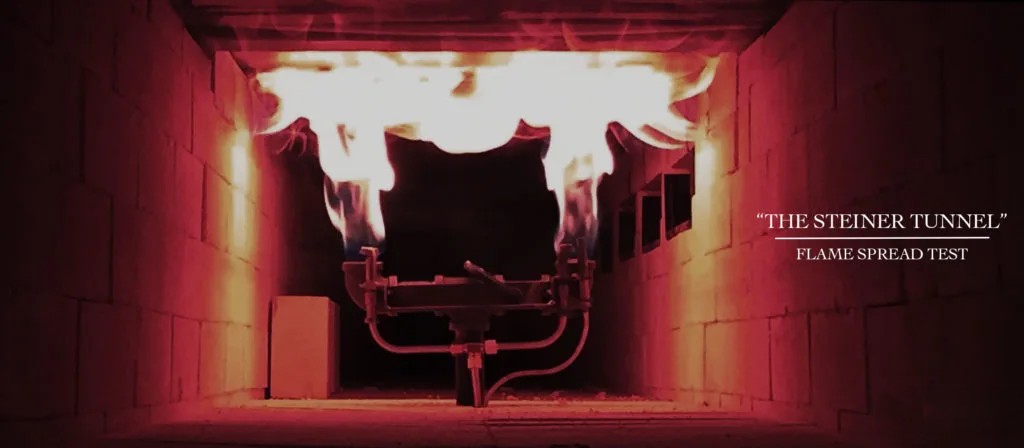
Wood fences burn. Vinyl fences burn and release toxic fumes while doing it. According to the National Fire Protection Association (NFPA), exterior fences and walls are an ignition pathway in roughly 7% of structure fires that spread to adjacent buildings. A non-combustible perimeter fence is one of the simpler risk reduction measures available, and some insurance carriers account for it in commercial property premiums.
Contractors bidding commercial jobs should reference the ASTM E84 test data in their specifications. Third-party Intertek documentation puts your bid ahead of competitors who cannot back up their fire performance claims. View the full fire test results on our ASTM E84 page.
Acoustic performance: fencing that actually blocks noise
Noise complaints cost money on commercial properties. Mixed-use developments, restaurants with patios, and multi-unit buildings near roads all deal with this. Most fence manufacturers never publish acoustic data because their products were never tested. PrimeAlux Privacy Plus panels were tested under ASTM E90 by Intertek (Report S8904.01-113-11-R0, 2025) and scored STC 22 and OITC 19.
STC 22 means the fence measurably reduces sound passing through it. For outdoor use, the OITC (Outdoor-Indoor Transmission Class) rating of 19 is the number that matters more. A fence is not a purpose-built sound wall, but these ratings confirm that Privacy Plus panels deliver real noise reduction compared to open picket, chain link, or gapped panel designs.
The National Research Council of Canada puts average traffic noise on urban commercial streets at 70 to 75 dB. Any measurable reduction at the property boundary helps with tenant satisfaction and complaint frequency. For hospitality and patio dining, acoustic fencing can help properties stay within municipal noise bylaws without expensive structural changes.
See the complete acoustic test data for spec details.
Wind load testing: built for Canadian weather
Wind resistance is where a lot of commercial fence installations fall apart. A 6-foot solid privacy panel catches serious wind, and if the system was not engineered for the load, you will see panels flexing, posts leaning, and hardware loosening within a couple of seasons.
PrimeAlux 6×6 privacy panels were wind load tested to 169.8 km/h. Underground-mounted posts (3 ft buried in concrete footings) tested to 226 km/h. On-ground posts with base plates and M8 anchor bolts tested to 153 km/h. These are independently verified numbers, not manufacturer estimates.
Environment and Climate Change Canada data shows southern Ontario gets wind gusts over 100 km/h an average of 3 to 5 times per year. Coastal and elevated commercial sites in Atlantic Canada and the prairies see worse. A fence system with documented wind load capacity protects the contractor from warranty claims and the property owner from repeat repair bills.
For commercial work, underground mounting is the way to go. The 9-foot post with 3 ft buried gives you the best wind resistance rating and eliminates base plate exposure in high-traffic areas. Review the wind load test PDF for the full engineering data.
Commercial panel styles: picking the right one for the job
Different commercial properties need different fence configurations. PrimeAlux makes three panel types that cover the range.
Privacy panels have zero-gap horizontal or vertical slat construction for full visual screening. Standard choice for multi-unit residential where tenant privacy matters, waste enclosures, mechanical equipment screening, and perimeter fencing next to residential neighbours. Sizes run from 4×6 up to 8×8 feet, with custom sizing on request. View privacy panel specifications.
Privacy Plus panels use reinforced 100mm x 20mm slats rated for 220 to 363 lbs of horizontal load depending on panel width. They pull double duty as perimeter fencing and structural guards on elevated decks, terraces, and rooftop patios where code requires guard-rated barriers. Inventive Consulting Group Ltd completed an engineering review (P.Eng. stamped, Dr. Feras Alsheet, December 2024) confirming guard compliance pending local authority approval. View Privacy Plus specifications.
Semi-privacy panels have controlled gaps between slats for airflow with partial screening. Good fit for restaurant patios, pool enclosures, and commercial properties that need a defined boundary without full visual block. The gap pattern also cuts wind load on the panel. View semi-privacy panel specifications.
| Application | Recommended panel | Why |
|---|---|---|
| Multi-unit residential perimeter | Privacy | Full tenant seclusion, noise reduction |
| Rooftop patio or elevated deck | Privacy Plus | Guard-rated, structural slat load capacity |
| Restaurant patio enclosure | Semi-Privacy | Airflow, partial screening, modern look |
| Waste and mechanical screening | Privacy | Full visual block, no gaps |
| Pool enclosure | Semi-Privacy or Privacy | Code-compliant heights, self-closing gate compatible |
| Retail frontage | Semi-Privacy | Street visibility with defined boundary |
| Hospitality property perimeter | Privacy Plus | Acoustic reduction + guard compliance |
Colour options for commercial projects
Commercial jobs often need colour matching to brand standards or architectural finishes. PrimeAlux ships five standard wood-grain finishes: Natural Walnut (WU-0384), Grey Walnut (WU-0201), Walnut (WU-0112), Dark Walnut (WU-0497), and Grey Brown (PL-0598). You get the look of natural wood without the upkeep.
The coating is a three-layer system: base coat for adhesion, colour coat, and clear coat for UV and scratch resistance. Posts and rails get powder coated. That multi-layer build is why the finish warranty goes up to 20 years, while most competitors top out at 5 years on coated steel.
For projects that need something outside the standard palette, reach out through the commercial inquiry form to discuss custom coating and lead times.
Gates for commercial projects
Every commercial fence job involves at least one gate, usually more. PrimeAlux aluminum gates come pre-assembled, match all panel styles, and ship in standard sizes: 2.6×5, 2.6×6, 4×5, and 4×6 feet. Pre-assembly saves 30 to 45 minutes of on-site labour per gate compared to field-assembled alternatives.
For wider openings, sliding gate configurations handle vehicle access, loading zones, and emergency routes. Self-closing hinges and magnetic latches meet pool fence code where applicable. The gate post profile (80mm x 80mm, 6063-T6 alloy, 2mm wall) is solid enough for motorized operators on automated entries.
Plan gate locations early in the layout so post spacing accommodates both the gate width and hinge hardware. See the full gate lineup for dimensions and hardware details.
Why contractors are specifying PrimeAlux on commercial bids
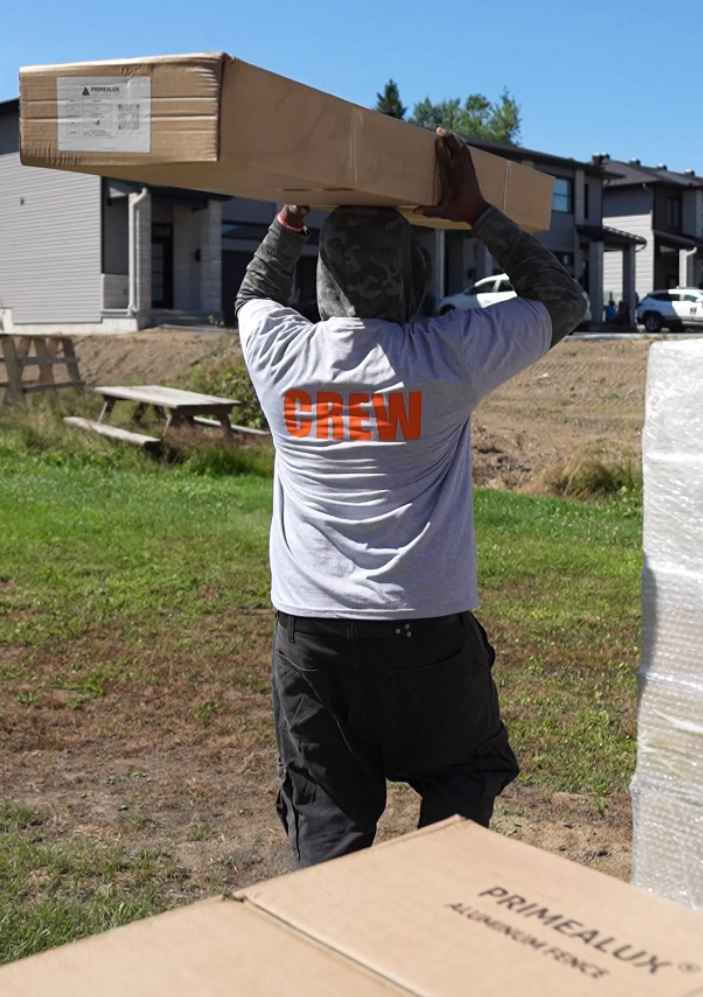
Canada’s commercial fencing demand is growing alongside the $18.7 billion multi-unit residential construction pipeline forecast through 2028 (IBISWorld, 2024). Contractors who lock in a reliable aluminum fence supplier win more bids and spend less time on warranty calls.
PrimeAlux systems arrive with pre-drilled posts, pre-cut panels, and all mounting hardware in the box. The install method is the same across every panel size and style. A crew that does one PrimeAlux job can do any PrimeAlux job without retraining. On-ground installs use base plates with M8 anchor bolts on existing concrete. Underground installs use standard concrete footings with 3 ft of post buried.
Dealers and distributors interested in carrying a commercial-grade aluminum fence line can get volume pricing and direct supply. Visit the About page for partnership info or contact us to talk commercial terms.
Frequently asked questions
What is a commercial aluminum fence?
A commercial aluminum fence is a perimeter system built from extruded aluminum alloy for higher-traffic sites with stricter building codes and longer expected service life. PrimeAlux uses 6063-T6 aluminum with multi-layer powder coat finishes and up to a 20-year finish warranty. These systems are used on multi-unit residential, retail, hospitality, and industrial properties.
How long does a commercial aluminum fence last?
Aluminum fencing lasts 25 years or more without scheduled maintenance. It does not rust like steel, and it does not rot, warp, or need staining like wood. PrimeAlux panels handle Canadian freeze-thaw cycles and are backed by wind load testing up to 226 km/h on underground-mounted posts.
Does aluminum fencing meet commercial fire codes?
PrimeAlux aluminum fence systems hold a Class A fire rating under ASTM E84 with a Flame Spread Index of 0 and Smoke Developed Index of 50, tested by Intertek (Report T0044.01-121-24, October 2025). Class A is the highest classification and satisfies most commercial fire code requirements for exterior perimeter barriers.
Can aluminum fencing reduce noise on commercial properties?
PrimeAlux Privacy Plus panels scored STC 22 and OITC 19 under ASTM E90 testing by Intertek. No fence replaces a purpose-built sound wall, but these panels measurably reduce noise transmission. They work well on mixed-use developments, restaurant patios, and properties along busy roads.
What is the strongest commercial fence panel available?
PrimeAlux Privacy Plus panels use reinforced 100mm x 20mm slats rated for 220 to 363 lbs of horizontal load depending on panel width. An engineering review by Inventive Consulting Group Ltd (P.Eng. stamped) confirms guard compliance for elevated applications pending local authority approval.
How is a commercial aluminum fence installed?
Two methods. On-ground mounting uses base plates with M8 anchor bolts on existing concrete. Underground mounting buries 3 ft of a 9-foot post in a concrete footing. Underground gives you the highest wind resistance (tested to 226 km/h) and works best for most commercial installs.
What colours are available for commercial aluminum fencing?
Five standard wood-grain finishes: Natural Walnut, Grey Walnut, Walnut, Dark Walnut, and Grey Brown. All use a three-layer coating (base, colour, clear coat) for UV and scratch resistance. Custom colours may be available on large commercial orders.
How does aluminum compare to chain link for commercial use?
Chain link gives you no privacy, no noise reduction, and no curb appeal. It rusts and sags. Aluminum costs more upfront but delivers full privacy, proven acoustic performance, Class A fire rating, and a 25-year-plus lifespan with zero maintenance. According to the National Association of Realtors (NAR), quality perimeter fencing adds to commercial property value and buyer perception.
