
Installing aluminum fence systems is one of the faster-growing service lines in the North American fencing market. Contractors who add aluminum cut labor hours per linear foot by roughly 30% compared to wood and see far fewer callbacks. The margins are better too, because there is less waste and less time on each job.
The aluminum fencing market reached USD 8.2 billion in 2023 and is projected to grow at 5.7% CAGR through 2030, according to Grand View Research. Homeowners and commercial buyers are choosing low-maintenance materials over wood and vinyl at an increasing rate. For contractors, that translates to more aluminum bid requests every season.
What tools do you need for installing aluminum fence?
A standard aluminum fence install requires fewer specialized tools than wood or chain-link work. You need a post hole digger or power auger (for underground installs), a hammer drill with masonry bits (for on-ground base plate installs), a level, a string line, tape measure, socket set for M8 anchor bolts, and a rubber mallet. Most crews already own everything on this list.
For on-ground installations, you will also need concrete anchor adhesive and a torque wrench. PrimeAlux panels use an 80mm x 80mm post profile with 2mm wall thickness in 6063-T6 aluminum alloy, so standard carbide drill bits handle the material without issue.
According to IBISWorld, the U.S. fence installation industry generated $12.7 billion in revenue in 2024, with aluminum and metal fence work growing faster than the overall industry. Contractors who carry aluminum as a primary line report stronger margins because material waste is lower and rework is rare.
Tool checklist by install method
| Tool | On-ground install | Underground install |
|---|---|---|
| Post hole digger / power auger | Not needed | Required (36″ depth minimum) |
| Hammer drill + masonry bits | Required (base plate anchoring) | Not needed |
| M8 socket set | Required | Not needed |
| Concrete mix | Anchor adhesive only | Full footing (per post) |
| Level + string line | Required | Required |
| Rubber mallet | Required | Required |
| Torque wrench | Recommended | Not needed |
How do you install aluminum fence posts correctly?
Post installation is where most problems start or get prevented. A crooked or poorly anchored post causes panel misalignment, gap issues, and warranty claims down the road. PrimeAlux offers two methods: on-ground mounting with a base plate and M8 anchor bolts, or underground burial with 3 feet of the 9-foot post set in concrete below grade.
Underground posts tested to 226 km/h wind resistance in third-party testing. On-ground posts handle 153 km/h. If you are working in a region with high wind exposure or local code requirements for guard-height fencing, underground is the safer spec.
The Aluminum Association reports that 6063-T6 alloy delivers a tensile strength of 241 MPa. Posts made from this grade hold up under sustained wind loading without bending or fatiguing, which matters on commercial projects where you are signing off on structural adequacy.
On-ground method (step by step)
- Mark post locations along the string line, spacing them to match panel width (6 ft or 8 ft centers)
- Position the base plate and mark anchor bolt holes on the concrete surface
- Drill anchor holes with the hammer drill (minimum 3″ depth into concrete)
- Set anchor bolts and tighten to manufacturer torque spec
- Slide the post over the base plate and secure with set screws
- Check plumb on two axes before moving to the next post
Underground method
- Dig post holes to a minimum of 36 inches below grade (below your local frost line)
- Pour 4 inches of gravel at the base for drainage
- Set the 9-foot post with 3 feet below grade
- Brace the post plumb and pour concrete footing
- Allow concrete to cure 24 to 48 hours before hanging panels
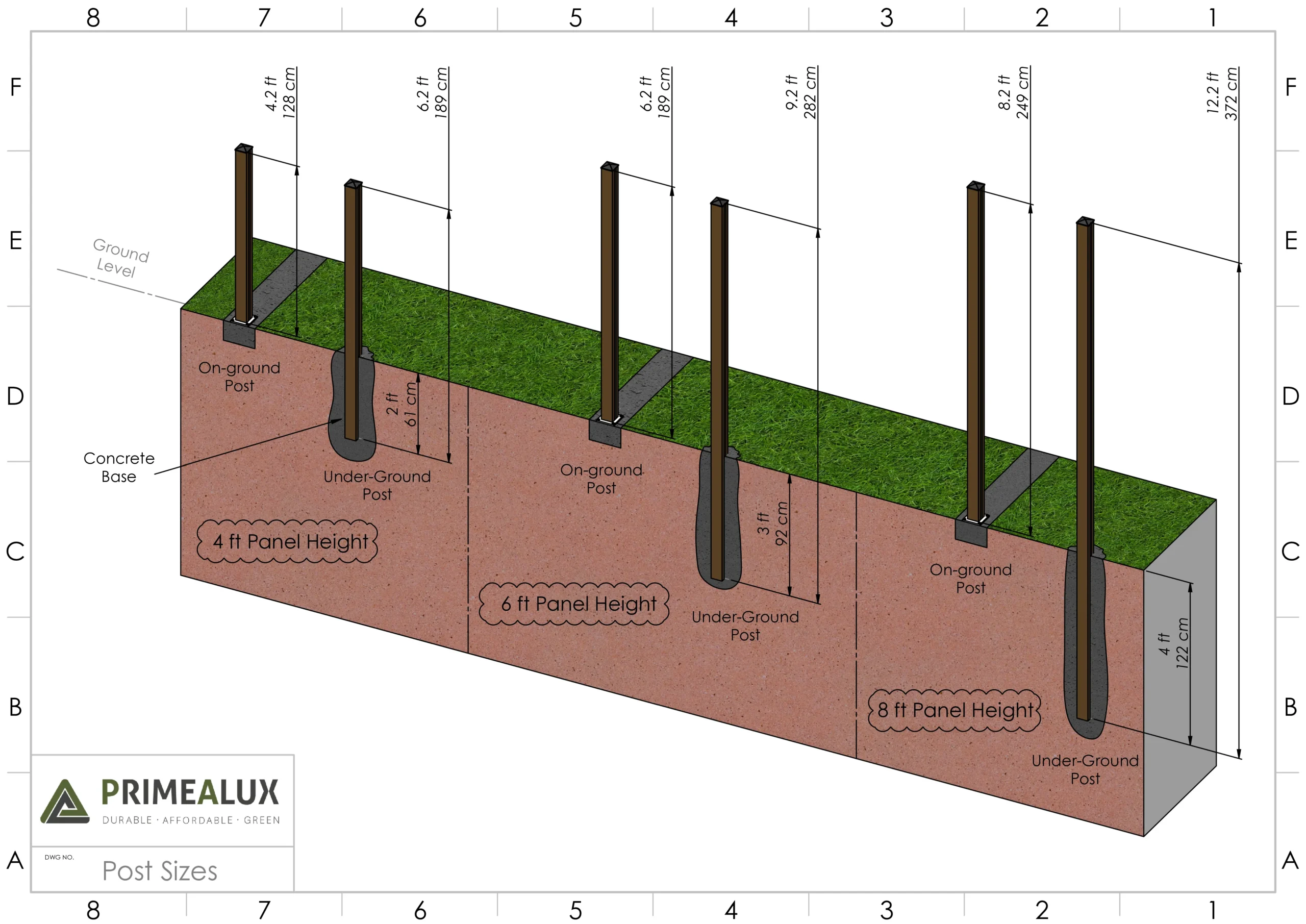
For Canadian contractors, frost depth is a real factor. In southern Ontario, the frost line sits at about 1.2 metres (4 feet). The 3-foot burial depth on PrimeAlux posts works in most moderate climate zones, but always check your local frost line data and municipal requirements before quoting.
What are the most common aluminum fence installation mistakes?
The three most frequent callbacks on aluminum fence jobs are misaligned panels from posts that were not plumbed properly, base plate anchors pulling out of cracked or thin concrete, and incorrect post spacing that forces field modifications to panel widths. All three are preventable.
According to Angi’s 2024 contractor survey, fence installation callbacks cost an average of $350 to $600 per visit when you factor in travel, labor, and replacement parts. On a 10-job month, even a 15% callback rate wipes out your profit on one or two of those jobs.
Mistake #1: Skipping the string line. Crews that eyeball post alignment instead of running a string line end up with a wavy fence line visible from 50 feet away. The fix takes 10 minutes at the start of the job or 4 hours after panels are hung.
Mistake #2: Anchoring into damaged concrete. On-ground base plates need solid, crack-free concrete at least 4 inches thick. If the existing slab is spalling or too thin, switch to underground posts or tell the client the concrete needs repair before you start.
Mistake #3: Ignoring thermal expansion. Aluminum expands and contracts with temperature swings. PrimeAlux panels are engineered with built-in tolerance for this, but if you force a tight fit on a cold morning, panels can buckle in summer heat. Leave the manufacturer-specified gap at connection points.
How does aluminum compare to other fence materials for installers?
Aluminum fence systems are faster to install and generate fewer callbacks than wood, vinyl, or chain-link. A two-person crew can put up 80 to 120 linear feet of aluminum privacy fence per day, compared to 50 to 70 linear feet for wood privacy, according to contractor field reports compiled by Principia Consulting.
| Factor | Aluminum (PrimeAlux) | Pressure-treated wood | Vinyl | Chain-link |
|---|---|---|---|---|
| Install speed (linear ft/day, 2-person crew) | 80-120 | 50-70 | 60-80 | 100-140 |
| Typical callbacks within 1 year | Less than 2% | 10-15% | 5-8% | 3-5% |
| Material waste on site | Under 3% | 8-12% | 5-7% | 4-6% |
| Post-install maintenance required | None | Staining in year 1-2 | None | Tension adjustment |
| Client satisfaction (repeat/referral rate) | High | Moderate | Moderate | Low |
| Expected lifespan in Canadian climate | 25+ years | 7-10 years | 10-15 years | 15-20 years |
The speed advantage comes from pre-engineered panel systems. PrimeAlux privacy panels and semi-privacy panels ship as complete assemblies. No on-site cutting, no board spacing, no staining. You set the posts, slide in the panels, and move on.
If you run crews on multiple job sites, consistency matters. Every PrimeAlux panel is the same dimensions and the same coating quality. Wood varies board to board, vinyl varies batch to batch, and that inconsistency eats time in the field.
What fire and safety ratings should contractors know?
PrimeAlux aluminum fence panels carry a Class A fire rating under ASTM E84 with a Flame Spread Index of 0 and a Smoke Developed Index of 50 (Intertek Report T0044.01-121-24, October 2025). That matters on commercial projects, multi-residential builds, and any job near property lines where fire code compliance is required.
Wood fencing does not hit Class A fire ratings without chemical treatment. Vinyl melts and produces toxic fumes. On commercial bids, specifying a material with verified fire test data puts your proposal ahead of competitors quoting wood or vinyl.
PrimeAlux Privacy Plus panels also have acoustic test data (STC 22, OITC 19 under ASTM E90, Intertek Report S8904.01-113-11-R0, 2025) and slat load test results showing 220 to 363 lbs horizontal load capacity depending on panel width. Those are real numbers you can include in bid packages for institutional and commercial clients.
How do you price aluminum fence installation jobs?
Material cost plus labor plus overhead plus margin is the standard formula, but aluminum jobs need a different labor estimate than wood. Installation is faster and callbacks are rare, so experienced contractors price aluminum at a higher per-foot rate while delivering the job in less time. The result is better effective hourly earnings.
According to Mordor Intelligence, the North American fencing market is expected to reach USD 14.8 billion by 2028, with aluminum and composite materials taking share from wood. Contractors who position aluminum as a premium offering rather than a commodity line item protect their margins.
When quoting aluminum gates, factor in the pre-assembled advantage. PrimeAlux gates arrive ready to hang, which eliminates the on-site assembly time that cuts into gate installation profits on wood and wrought iron jobs. Gate sizes range from 2.6 ft x 5 ft to 4 ft x 6 ft in matching finishes.
What colours and finishes are available for contractor projects?
PrimeAlux offers five standard colours: Natural Walnut (WU-0384), Grey Walnut (WU-0201), Walnut (WU-0112), Dark Walnut (WU-0497), and Grey Brown (PL-0598). Structural components are powder coated. Slats get a 3-layer coating system (base coat, colour coat, clear coat) backed by up to a 20-year finish warranty.
Five finishes might sound limited, but it simplifies the sales conversation. You are not managing 30 custom swatches and long lead times. These five cover the vast majority of residential and commercial design requests. The wood-grain finishes give clients the look of timber without the rot, warping, or repainting that comes with actual wood in Canadian weather.
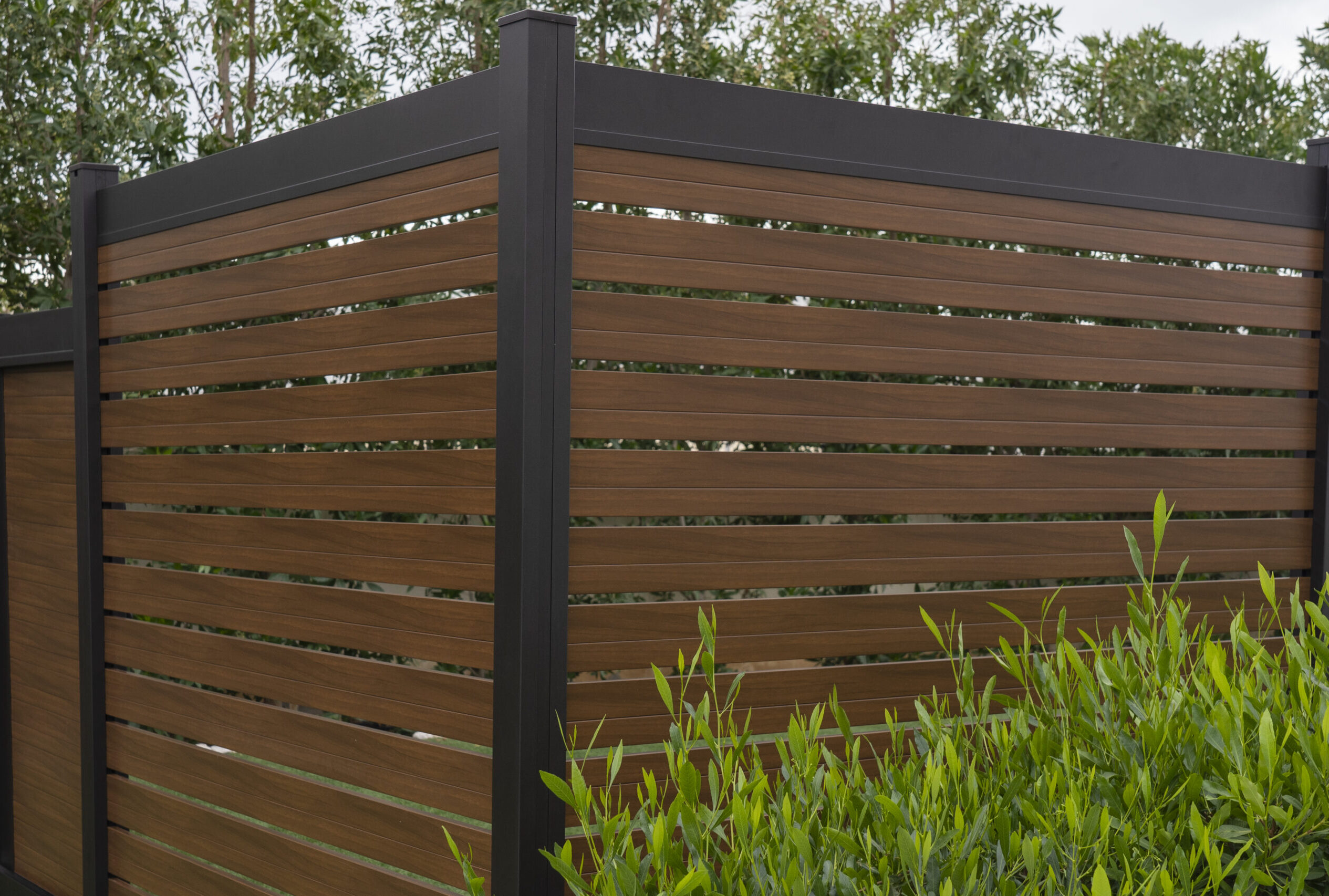
Homeowners looking at aluminum privacy screens or aluminum pergolas can match the same colour line across their whole outdoor project, which makes upselling additional products easier for contractors and dealers.
Where can contractors source PrimeAlux products?
PrimeAlux supplies contractors, dealers, and distributors directly from their Mississauga, Ontario facility at 2222 South Sheridan Way, Unit 116. For project quotes, bulk pricing, and dealer program details, contact PrimeAlux directly. The FAQ page covers common technical and ordering questions, and you can check service locations for regional availability.
Standard panel sizes are in stock (4×6, 4×8, 6×6, 6×8, 8×6, 8×8 feet), and custom sizing is available for commercial specs. If you are bidding on a larger project, get in touch with the PrimeAlux team early to lock in inventory and avoid lead time surprises.
Frequently asked questions
How long does it take to install aluminum fence panels?
A two-person crew typically installs 80 to 120 linear feet of aluminum privacy fence per day, depending on terrain and install method. On-ground base plate installations are faster since there is no digging or concrete curing. Underground post installs add time for augering and concrete setting.
Do you need special tools to install aluminum fence?
No. Standard construction tools cover both installation methods: a hammer drill and M8 socket set for on-ground installs, or a power auger and concrete supplies for underground installs. Most fence contractors already own everything needed.
What is the recommended post depth for aluminum fence in Canada?
PrimeAlux underground posts are designed for 3 feet (36 inches) of burial below grade. In Canadian regions where the frost line exceeds this depth, check your local building code. Southern Ontario frost depth sits around 1.2 metres (4 feet), so verify your municipality’s requirements before quoting.
Can aluminum fence withstand Canadian winters?
Yes. Aluminum does not crack, warp, or become brittle in cold temperatures the way vinyl does. PrimeAlux panels were wind-load tested to 169.8 km/h (6×6 privacy panel), and underground posts held to 226 km/h. The multi-layer coating resists UV, salt, and freeze-thaw cycles.
What fire rating do PrimeAlux aluminum fence panels have?
PrimeAlux panels achieved a Class A fire rating under ASTM E84 testing with a Flame Spread Index of 0 and Smoke Developed Index of 50 (Intertek Report T0044.01-121-24, October 2025). Class A is the highest fire safety classification for building materials.
How do aluminum fence installation costs compare to wood?
Aluminum material costs are higher per linear foot, but total project costs are competitive because installation is 30 to 40 percent faster and material waste is almost zero. Callback rates below 2 percent mean fewer warranty visits eating into your margin over the first year.
Are PrimeAlux panels pre-assembled?
Yes. Privacy panels, semi-privacy panels, and gates arrive pre-assembled and ready to install. No on-site slat spacing, board cutting, or hardware assembly needed. That is a significant time saver compared to wood builds where every board is handled individually.
What warranty does the PrimeAlux finish carry?
The multi-layer powder coat finish is backed by up to a 20-year warranty. Structural components are powder coated separately. That gives contractors confidence when promising long-term performance to clients.
