
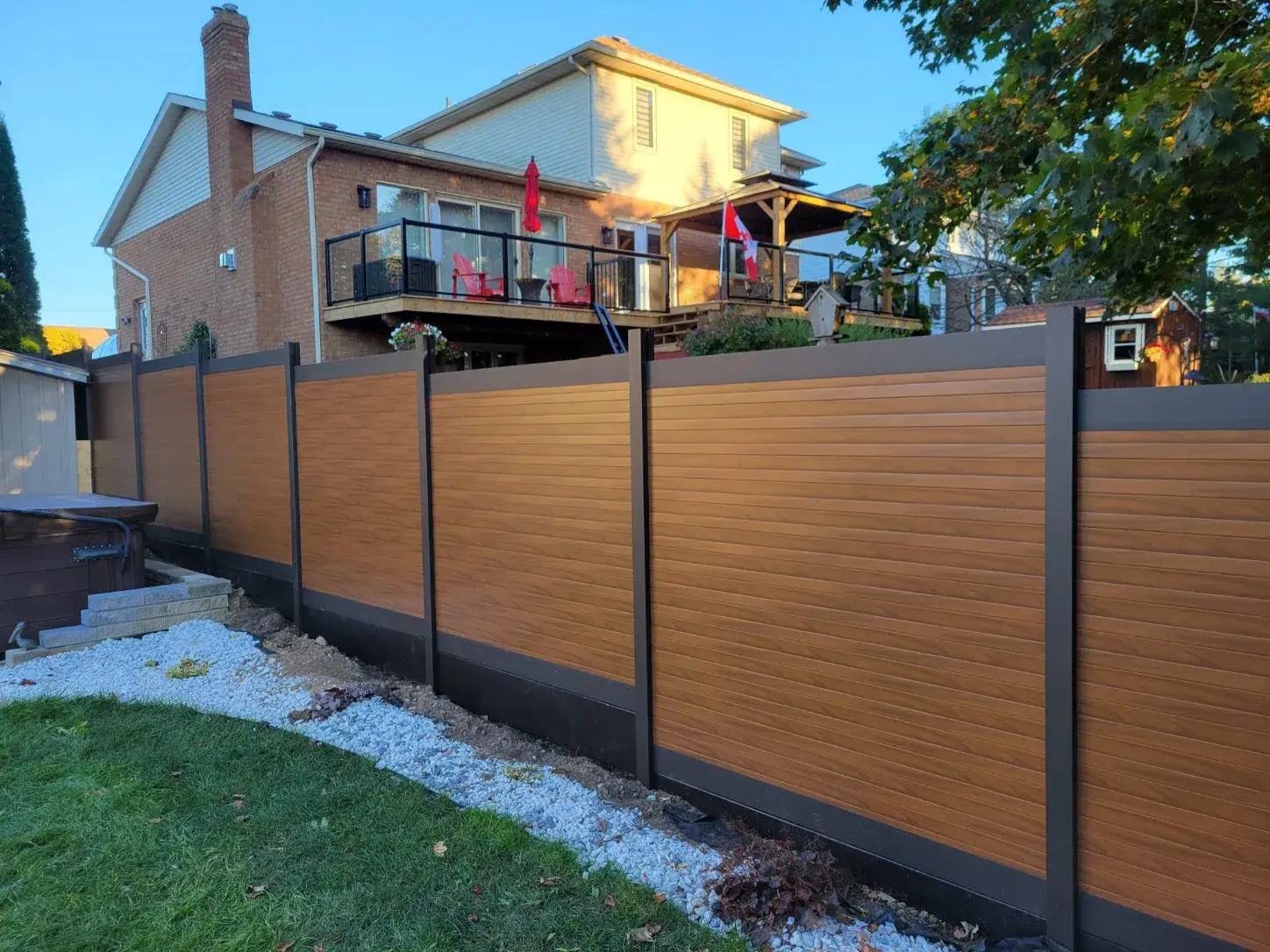

What Is an Aluminum Privacy Fence?
An aluminum privacy fence is a horizontal or vertical slat panel system made from extruded 6063-T6 aluminum alloy that blocks sightlines completely between properties. Unlike ornamental aluminum picket fences with open gaps, privacy versions use interlocking slats with zero spacing to create full visual screening. These panels resist corrosion, require no painting or staining, and hold up through Canadian freeze-thaw cycles without cracking, warping, or rotting.
The global aluminum fencing market reached USD 4.98 billion in 2023 and is projected to hit USD 7.2 billion by 2031, growing at 5.45% CAGR according to Verified Market Research. That growth tracks directly with homeowner and contractor demand for low-maintenance, long-lifespan fencing that outperforms wood, vinyl, and steel in harsh climates.
PrimeAlux manufactures aluminum privacy fence panels in standard sizes including 4×6, 4×8, 6×6, 6×8, 8×6, and 8×8 feet, with custom sizing available. Every panel uses a three-layer coating system (base coat, colour coat, clear coat) backed by up to a 20-year finish warranty. For contractors and installers looking at privacy aluminum fence panels, these specs matter because they translate directly to fewer callbacks and warranty claims.
How Does an Aluminum Privacy Fence Compare to Wood, Vinyl, and Steel?
Aluminum privacy fencing outlasts every competing material in Canadian conditions while requiring zero ongoing maintenance. Cedar wood fences last 8 to 12 years before base rot, grey boards, and warping force replacement. Pressure-treated wood holds up 7 to 10 years before visible deterioration sets in. Vinyl cracks below minus 20 degrees Celsius and yellows from UV exposure within 10 to 15 years. Steel rusts once galvanizing wears through at cut ends and below grade level.
| Material | Realistic Canadian Lifespan | Maintenance Required | Cold Weather Performance | Cost per Linear Foot (Installed) |
|---|---|---|---|---|
| Aluminum (PrimeAlux) | 25+ years | None | No cracking, no warping | $110 to $160 |
| Cedar Wood | 8 to 12 years | Staining every 2 to 3 years | Warps, splits, rots at base | $50 to $90 |
| Pressure-Treated Wood | 7 to 10 years | Annual treatment, post replacement | Green algae, warping, leaning | $40 to $75 |
| Vinyl | 10 to 15 years | Panel replacement (cannot repair) | Brittle below minus 20C, cracks from impacts | $55 to $100 |
| Steel | 15 to 20 years (with maintenance) | Rust treatment, repainting every 3 to 5 years | Holds structurally, coating fails | $70 to $130 |
According to HomeStars, Canadian homeowners spend between $3,000 and $8,000 on average fence installations. The upfront cost of aluminum runs higher than wood, but when you factor in zero maintenance costs over 25 years versus $500 to $800 every two years for wood staining (that most owners skip anyway), aluminum wins the total cost comparison within 7 to 10 years.
For contractors quoting projects, this cost-of-ownership argument closes deals. A client choosing a 100-linear-foot PrimeAlux aluminum privacy fence at $140 per foot spends $14,000 once. The same client choosing cedar at $70 per foot spends $7,000 upfront plus $6,000 to $10,000 in staining, repairs, and eventual replacement over the same 25-year window.
What Wind Load Can Aluminum Privacy Fences Handle?
PrimeAlux 6×6 privacy panels have been wind-load tested to withstand sustained winds of 169.8 km/h. Underground-mounted posts (80mm x 80mm profile, 2mm wall thickness, with 2.8 feet buried in concrete) tested to 226 km/h. On-ground base plate installations tested to 153 km/h. These are third-party verified numbers, not manufacturer claims.
Wind resistance is the single biggest structural concern for privacy fencing because solid panels act as a sail. This is where most vinyl and wood privacy fences fail first. Environment and Climate Change Canada reports that Southern Ontario regularly sees wind gusts exceeding 90 km/h during spring and fall storm systems. PrimeAlux panels tested nearly double that threshold.
The post system drives the wind performance. PrimeAlux uses 6063-T6 aluminum alloy posts with an 80mm x 80mm cross-section and 2mm wall thickness. For underground installation, 9-foot posts are buried 2.8 feet deep in concrete footings, leaving 6.2 feet above grade. For on-ground installation, base plates secure to concrete pads using M8 anchor bolts. You can review the full engineering data in the PrimeAlux wind load test report.
Is Aluminum Privacy Fencing Fire Rated?
PrimeAlux aluminum privacy fence panels earned a Class A fire rating under ASTM E84 testing conducted by Intertek (Report T0044.01-121-24, October 2025). The panels recorded a Flame Spread Index of 0 and a Smoke Developed Index of 50. Class A is the highest fire rating available for building materials.
This matters for properties in wildfire-prone zones, commercial installations near buildings, and any project where building code requires fire-rated materials at property lines. Wood fences are a known fire transmission vector between structures. According to the National Fire Protection Association (NFPA), wooden fences and landscaping are among the most common pathways for fire spread between residential structures during wildfire events.
Contractors working on commercial or multi-residential projects can reference the ASTM E84 fire test results directly when specifying materials for permit applications. A Flame Spread Index of 0 means the material did not contribute to flame propagation at all during testing.
Does Aluminum Privacy Fencing Block Noise?
PrimeAlux Privacy Plus panels achieved an STC (Sound Transmission Class) rating of 22 and an OITC (Outdoor-Indoor Transmission Class) rating of 19 under ASTM E90 testing conducted by Intertek (Report S8904.01-113-11-R0, 2025). These panels use 100mm x 20mm reinforced slats that support 220 to 363 lbs of horizontal load depending on panel width.
An STC 22 rating means the fence provides measurable noise reduction for road traffic, lawnmowers, and general neighbourhood sounds. For context, a standard interior wall rates STC 33 to 35. No fence will match a wall, but Privacy Plus panels deliver more acoustic dampening than wood or vinyl alternatives because the reinforced aluminum slats are denser and have tighter tolerances between slats.
Review the complete acoustic testing methodology and results on the ASTM E90 acoustic test page. This data is useful for projects near highways, commercial loading areas, or anywhere clients are asking about sound reduction as part of the fence specification.
What Styles of Aluminum Privacy Fence Are Available?
PrimeAlux offers three distinct aluminum privacy fence configurations, each designed for different applications and client requirements. The choice depends on the balance between full visual screening, airflow, and structural load capacity.
Privacy Panels (Full Screening)
Privacy aluminum fence panels use zero-gap horizontal or vertical slats that block 100% of sightlines. This is the standard choice for residential property lines, pool enclosures, and any application where complete visual screening is the priority. Available in all standard sizes from 4×6 to 8×8 feet.
Privacy Plus Panels (Structural Grade)
Privacy Plus panels use reinforced 100mm x 20mm slats that combine full privacy with guard-level structural performance. An engineering review by Inventive Consulting Group Ltd (P.Eng. stamped, Dr. Feras Alsheet, December 2024) confirms guard compliance pending local authority approval. These panels support 220 to 363 lbs of horizontal load, making them suitable for elevated decks, balcony guards, and commercial applications requiring code-compliant barriers.
Semi-Privacy Panels (Controlled Gaps)
Semi-privacy fence panels feature controlled spacing between slats that allows airflow and filtered light while still limiting direct sightlines. These are popular for front yards, pool areas where code requires visibility, and properties where full screening feels too enclosed. The gap width provides a balance between privacy and openness that many homeowners prefer over solid panels.
| Feature | Privacy Panels | Privacy Plus Panels | Semi-Privacy Panels |
|---|---|---|---|
| Visual Screening | 100% | 100% | Partial (controlled gaps) |
| Airflow | Minimal | Minimal | Good |
| Horizontal Load Capacity | Standard | 220 to 363 lbs | Standard |
| Guard Compliance | No | Yes (pending local approval) | No |
| Best For | Property lines, pool enclosures | Decks, balconies, commercial | Front yards, pool areas with visibility codes |
How Is an Aluminum Privacy Fence Installed?
Aluminum privacy fence installation uses one of two mounting methods: underground post burial in concrete footings or on-ground base plate attachment to existing concrete surfaces. The method depends on site conditions, local code requirements, and whether the installation is new construction or retrofit.
Underground Installation
Underground installation uses 9-foot posts with 2.8 feet buried in concrete footings, leaving 6.2 feet above grade. This method provides maximum wind resistance (tested to 226 km/h) and is the preferred approach for permanent perimeter fencing. Dig post holes to a minimum 36-inch depth, set posts plumb, pour concrete, and allow 24 to 48 hours for curing before attaching panels.
On-Ground Installation
On-ground installation uses 6.2-foot posts mounted to base plates with M8 anchor bolts drilled into existing concrete pads, patios, or footings. Wind resistance is rated to 153 km/h. This method works well for deck-mounted installations, rooftop applications, and any situation where digging is not feasible. Base plates distribute load across the mounting surface.
According to Grand View Research, the metal fencing segment accounted for over 52% of fencing market revenue in 2023, driven partly by faster installation times compared to wood and masonry alternatives. Aluminum panel systems install 30 to 40% faster than board-by-board wood fencing because panels arrive pre-assembled and attach directly to posts with concealed hardware.
For contractors handling multiple installations, pre-assembled aluminum gates in matching styles (available in 2.6×5, 2.6×6, 4×5, and 4×6 foot sizes) reduce on-site fabrication time and ensure colour consistency across the project.
What Colours Are Available for Aluminum Privacy Fences?
PrimeAlux offers five standard wood-grain finish colours across all privacy fence products: Natural Walnut (WU-0384), Grey Walnut (WU-0201), Walnut (WU-0112), Dark Walnut (WU-0497), and Grey Brown (PL-0598). Each finish uses a three-layer coating process with a base coat, colour coat, and clear coat, backed by up to a 20-year warranty on the finish.
Wood-grain finishes are the fastest-growing segment in the residential fencing market. The Mordor Intelligence fencing market report notes that aesthetic customization is a primary purchase driver for residential fence buyers, with natural wood-look finishes gaining market share over solid colours. PrimeAlux wood-grain finishes deliver the appearance of real timber without any of the maintenance, fading, or weathering that actual wood brings in Canadian conditions.
Structural components (posts, rails, brackets) receive standard powder coating, while slats get the premium three-layer treatment because slats are the visible surface area. This distinction matters for installers pricing jobs accurately and explaining the coating difference to clients who ask why the posts look slightly different from the panels up close.
How Much Does an Aluminum Privacy Fence Cost in Canada?
Aluminum privacy fencing in Canada ranges from $110 to $160 per linear foot installed, depending on panel height, style, and installation method. A typical 100-linear-foot residential project runs $11,000 to $16,000 including posts, panels, gates, and professional installation. This is higher upfront than wood ($4,000 to $9,000) but eliminates all future maintenance spending.
According to Angi’s 2026 fencing data, aluminum fencing averages $40 to $75 per linear foot for standard ornamental styles in the U.S. Canadian pricing runs higher due to currency differences, shipping costs, and the premium specifications required for privacy-rated panels versus open picket styles.
For contractors building quotes, contact PrimeAlux directly for current dealer and volume pricing. The company supports contractors through its distribution locations with sample programs and quoting tools that help close residential and commercial projects faster.
Does an Aluminum Privacy Fence Meet Ontario Building Code?
PrimeAlux Privacy Plus panels have been reviewed by Inventive Consulting Group Ltd with a P.Eng. stamp from Dr. Feras Alsheet (December 2024) confirming guard compliance pending local authority approval. The reinforced slat design (100mm x 20mm slats supporting 220 to 363 lbs horizontal load) meets the structural load requirements specified in the Ontario Building Code for guards.
The key phrase is “pending local authority approval” because building code compliance ultimately requires sign-off from the local building inspector or authority having jurisdiction. The P.Eng. review provides the structural documentation that inspectors need to approve the installation. For detailed information on how PrimeAlux products align with OBC requirements, contractors and specifiers can review the full documentation through the slat load testing page.
According to Redfin, homes with fences can sell for up to 10% more than comparable unfenced properties. When the fence also meets building code as a guard, it adds both property value and functional compliance, which is especially relevant for elevated installations on decks and terraces where guards are code-mandated.
Why Choose Aluminum Over Other Privacy Fence Materials?
Aluminum is the only privacy fence material that delivers zero maintenance, full corrosion resistance, verified wind and fire performance, and a 25-plus year lifespan in Canadian conditions. No other material checks all four boxes simultaneously. Wood rots. Vinyl cracks in cold. Steel rusts. Chain link provides no privacy at all.
The fencing market confirms this shift. Grand View Research projects the global fencing market will reach USD 36.44 billion by 2026, with metal fencing holding the largest revenue share. Within that segment, aluminum is gaining ground against steel because it offers similar structural performance without the corrosion risk.
For contractors and installers building a fence business, aluminum privacy panels offer better margins and fewer service calls than wood. A wood fence installed today will generate warranty requests within 3 to 5 years. An aluminum fence installed today will not. That difference in post-installation support costs is why contractors switching to aluminum report better profitability per project even at comparable labour rates. Browse the full range of aluminum privacy screens and aluminum sunroof pergolas to see how PrimeAlux products extend beyond fencing into complete outdoor systems.
Frequently Asked Questions
How long does an aluminum privacy fence last in Canada?
An aluminum privacy fence lasts 25 years or more in Canadian conditions with zero maintenance required. The 6063-T6 aluminum alloy does not rust, rot, warp, or crack through freeze-thaw cycles. PrimeAlux backs the three-layer powder coat finish with up to a 20-year warranty. Most installations outlast the property ownership cycle without any repairs.
Can aluminum privacy fencing withstand Canadian winters?
Yes. Aluminum does not become brittle in cold temperatures the way vinyl does below minus 20 degrees Celsius. PrimeAlux panels are wind-load tested to 169.8 km/h, and underground posts handle up to 226 km/h. Snow, ice, and salt spray do not affect the aluminum structure or the multi-layer coating system.
Is aluminum fencing more expensive than wood?
Aluminum costs $110 to $160 per linear foot installed compared to $40 to $90 for wood. The upfront price is higher, but aluminum requires zero maintenance over its 25-plus year lifespan. Wood needs staining every 2 to 3 years and typically requires replacement within 8 to 12 years. Over 20 years, aluminum costs less in total.
Does aluminum privacy fencing require maintenance?
No regular maintenance is needed. Occasional rinsing with a garden hose removes dirt and pollen. There is no staining, painting, sealing, or rust treatment required at any point during the product lifespan. The powder coat finish resists UV fading, and aluminum alloy is inherently corrosion-proof.
Can I install aluminum privacy fence panels myself?
DIY installation is possible for homeowners comfortable with post hole digging and basic construction. Panels arrive pre-assembled and attach to posts with concealed hardware. Underground installation requires digging to 36-inch depth and pouring concrete footings. On-ground base plate installation is simpler and requires only anchor bolt drilling into existing concrete.
What height of aluminum privacy fence should I choose?
Six-foot panels are the most common residential choice because they provide full standing-height privacy. Eight-foot panels suit commercial applications, pool enclosures, or properties adjacent to busy roads. Four-foot panels work for decorative boundary marking where full screening is not the priority. Check local bylaws for maximum allowable fence height before ordering.
Are aluminum privacy fences good for pool enclosures?
Aluminum is ideal for pool enclosures because it does not corrode from chlorine splash, pool chemicals, or standing moisture. Semi-privacy panels meet pool fencing requirements that mandate partial visibility while still limiting access. Self-closing aluminum gates with matching finishes complete the enclosure.
Where can I see aluminum privacy fence products in person?
PrimeAlux operates a showroom at 2222 South Sheridan Way, Unit 116, Mississauga, Ontario. Contractors, dealers, and homeowners can view full-size panel samples in all five standard colours, test hardware, and discuss project specifications. Contact PrimeAlux to book a showroom visit or request shipped samples.
