
Sliding gate hardware fails more often than the gate itself. Wrong roller selection, undersized track, and mismatched weight capacity are the top reasons contractors get callbacks on gate installations, and the fixes are expensive. This guide covers what to spec, what to avoid, and how to match hardware to the job before the concrete sets.
What types of sliding gate hardware do contractors need?
A complete sliding gate system has four core hardware components: a bottom track or cantilever rail, bottom rollers (or cantilever rollers), a guide at the top or far end, and an end stop. Each component handles a specific load, and undersizing any one of them creates the weakest link in the system.
Bottom-track systems use a channel or V-groove track embedded in or laid on the driveway surface. The gate rides on rollers that sit inside the track. These systems are common on residential jobs and lighter commercial gates up to about 400 lbs. The main limitation is the exposed track: it collects debris, ice, and gravel, which grinds rollers prematurely.
Cantilever systems eliminate the bottom track entirely. The gate is suspended from an overhead beam using two sets of rollers mounted to posts. The gate extends past the opening by roughly 1.5 times the gate width (the cantilever section counterbalances the opening span). No track means nothing to fill with debris, which makes cantilever hardware the standard choice for commercial, industrial, and any site where track maintenance is impractical.
According to the Door and Access Systems Manufacturers Association (DASMA), cantilever gates account for over 60% of commercial sliding gate installations in North America because of their reduced maintenance requirements and reliability in freeze-thaw climates.
Cantilever vs track-mounted sliding gate systems: which should you specify?
Cantilever systems outperform track-mounted systems on almost every metric that matters to commercial buyers, but they cost more upfront and require longer gate panels. The spec decision usually comes down to site conditions and total lifecycle cost, not purchase price.
| Factor | Track-Mounted System | Cantilever System |
|---|---|---|
| Opening width limitation | Up to ~20 ft residential | Up to 40+ ft commercial |
| Debris and ice impact | High (track fills, rollers grind) | None (no ground contact) |
| Installation complexity | Lower (track embedded or surface-laid) | Higher (post footings critical) |
| Gate panel length required | Equal to opening width | 1.5x opening width (cantilever overhang) |
| Maintenance calls per year | Higher (track clearing, roller replacement) | Lower (roller inspection only) |
| Best suited for | Residential, flat paved surfaces | Commercial, uneven terrain, high traffic |
For residential aluminum gate jobs, track-mounted hardware often makes sense when the driveway is paved and maintained. On any commercial property, multi-unit development, or site with gravel approaches, cantilever is the correct spec from day one. Recommending track hardware on the wrong site generates callbacks and eats margin on warranty repairs.
How to match sliding gate hardware to gate weight and panel width
Every piece of sliding gate hardware carries a weight rating. Exceed it and the rollers flatten, the track deforms, or the post anchors pull. Hardware manufacturers rate components by kilograms or pounds of gate weight, not panel size alone. A 10-foot gate in heavy steel weighs three times what the same span weighs in aluminum.
Aluminum gates are much lighter than steel equivalents, which changes what hardware you need to spec. A standard 6-foot aluminum gate panel from PrimeAlux, designed to pair with their aluminum gate system, weighs a fraction of what comparable steel would, which means you can spec lighter-duty hardware at lower cost without dropping below the rated capacity you need.
As a working rule:
- Always spec hardware rated for at least 25% above actual gate weight
- Account for wind load: a 10 ft gate in a 100 km/h wind zone sees real lateral force on rollers
- Gate width matters for deflection: wider panels flex more; stiffer aluminum profiles reduce this
- Post spacing for cantilever systems is critical. Follow the hardware manufacturer’s post center spec exactly
The American Society of Civil Engineers (ASCE 7-22) provides wind load tables commonly referenced for gate and fence system design. For sites in wind-exposed areas, confirm the gate panel and hardware combination has been tested or rated against local wind zone requirements. PrimeAlux fence and gate systems are wind load tested to 220 km/h, which matters when you are specifying hardware for the system as a whole.
Material choices for sliding gate hardware: what holds up in Canadian climates
Sliding gate hardware is available in galvanized steel, stainless steel, powder-coated steel, and aluminum-compatible options. In Canadian freeze-thaw conditions, material choice determines how long the hardware lasts before corrosion creates operational problems.
| Hardware Material | Corrosion Resistance | Best Application | Estimated Lifespan |
|---|---|---|---|
| Hot-dip galvanized steel | Good (zinc sacrificial layer) | Residential, protected installations | 10–15 years before rust onset |
| Stainless steel (304/316) | Excellent (no sacrificial layer needed) | Coastal, high-exposure, commercial | 25+ years with basic maintenance |
| Powder-coated steel | Moderate (coating chips at contact points) | Aesthetic match, low-traffic sites | 5–10 years before pitting |
| Aluminum-core rollers | Excellent (inherently non-corrosive) | Aluminum gate systems, marine zones | 20+ years |
Galvanic corrosion is a specific concern when mixing metal types. Aluminum gate panels in contact with steel hardware will corrode: the steel acts as a cathode and accelerates oxidation of the aluminum. Use nylon bushings, aluminum-compatible rollers, or stainless fasteners wherever hardware contacts the gate panel directly. This is one of the most common installation errors contractors miss, and it shows up as white powder corrosion on the gate frame within a few years.
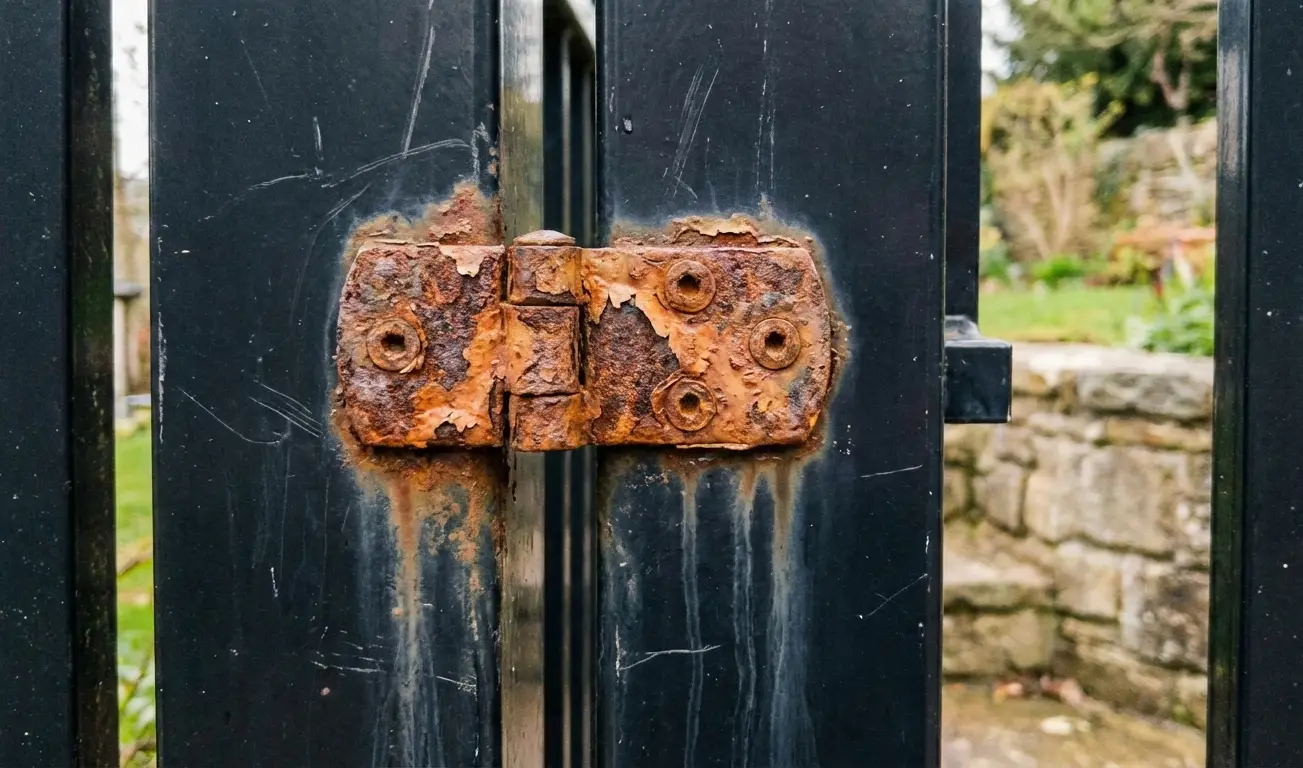
The galvanic corrosion risks in fence hardware are well documented and worth reviewing before specifying mixed-metal assemblies on any gate job.
Common sliding gate hardware installation mistakes that generate callbacks
Most callback-generating gate failures trace back to five installation errors. None are complicated to avoid. They just require attention to spec rather than guessing at site.
Underrated hardware: Contractors sometimes use the same hardware kit for every gate regardless of size. A 400 lb weight-rated roller assembly used on a 600 lb gate will flatten within one season. Always verify the rated capacity against actual gate weight, not panel dimensions alone.
Post footings too shallow: Cantilever gate posts take significant lateral and vertical load. Footings below frost depth in Canadian climates will heave. The same 3-foot burial depth required for fence posts (following local code) applies to gate posts, and cantilever posts often need deeper footings because of the moment forces involved. Reference proper aluminum fence post sizing and installation for baseline footing requirements.
Track not properly leveled: Even a few millimeters of slope across the track run causes the gate to drift open or closed under its own weight. This is nearly impossible to fix after concrete has cured. Set track level and use shims during installation before concrete is poured.
End stop undersized or missing: End stops take the full kinetic energy of a moving gate. On motorized systems this is considerable. Use a rubber-buffered end stop rated for the gate weight and travel speed. Missing end stops cause frame damage and roller misalignment within weeks of use.
Ignoring gate sag: Wide aluminum gates can sag over time at the latch end if the panel frame is undersized. Gate sag is one of the most common fence system mistakes, and preventing it starts with specifying the right panel stiffness, not just the right hardware.
Sliding gate hardware for commercial vs residential applications
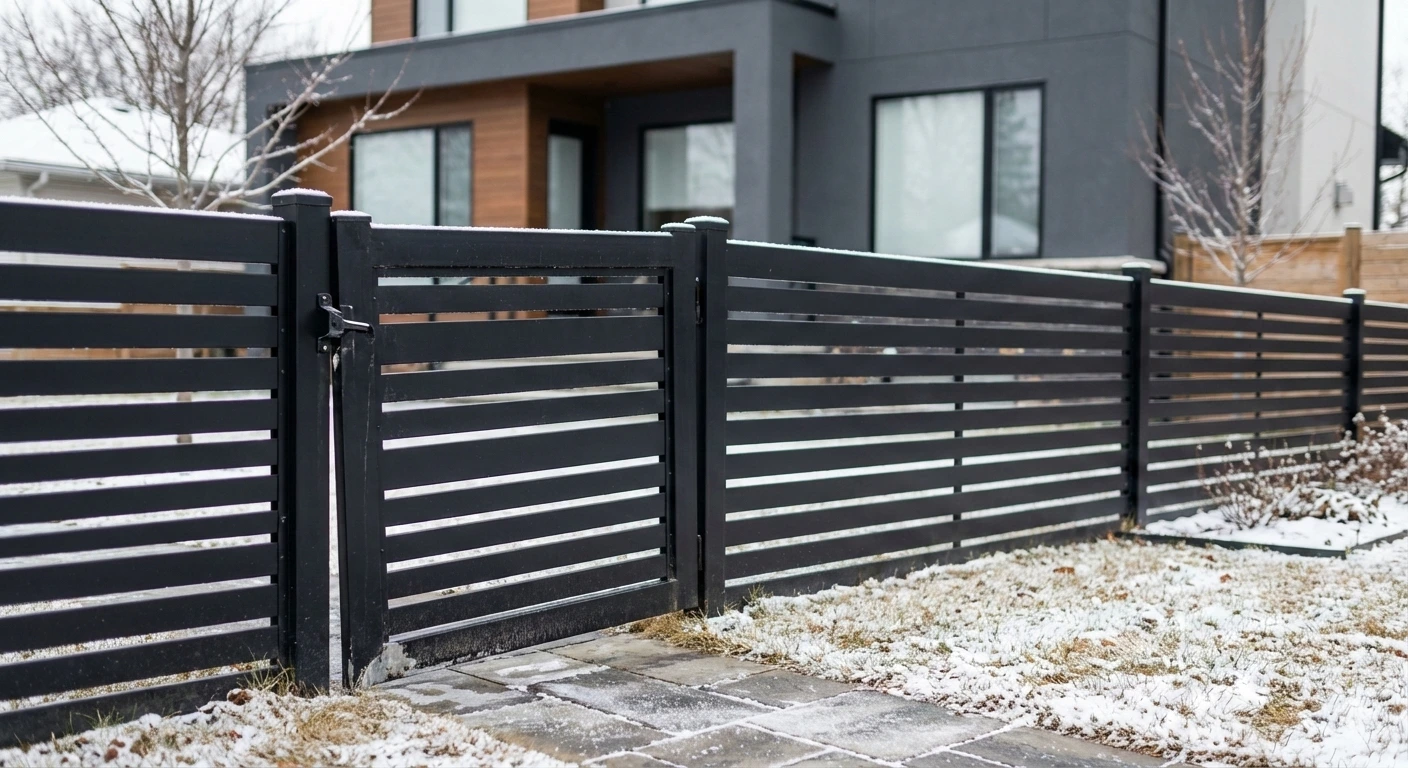
Commercial sliding gate jobs have different hardware requirements than residential ones, even when the opening dimensions are similar. Traffic volume, motorization, access control integration, and code requirements all shape the hardware spec.
On commercial aluminum fence and gate systems, the hardware has to accommodate automated operators. That means reinforced roller brackets that accept operator mounting, bottom guides that allow the motor drive to engage cleanly, and end stops with limit switch compatibility. Not all residential-grade hardware kits have these features.
For multi-unit residential developments and commercial perimeter security, cantilever hardware rated at 1,000 lbs and above is standard. These systems use 100mm or 120mm roller assemblies and require heavy-gauge post plates anchored to concrete footings. The gate panels for these applications are typically aluminum box-section frames rather than slat-style fence panels. The structural requirements are different from residential privacy fence gates.
PrimeAlux aluminum gates are available in configurations suited to both residential and commercial applications. Their aluminum construction means a lighter gate panel for the same visual span, reducing the hardware weight class required and often lowering the total installed cost versus steel-framed equivalents. For contractor sourcing and system specifications, visit the PrimeAlux aluminum gate product page.
When specifying aluminum fence gate systems for commercial jobs, confirm with the hardware supplier that the roller and track assemblies are rated for continuous-duty cycling if automated operators are involved. Residential-duty hardware degrades quickly under commercial traffic volumes.
Sourcing sliding gate hardware: what to look for in a supplier
Not all gate hardware suppliers stock the same quality. A few things to confirm before placing an order:
- Weight certifications: Ask for load test documentation on rollers. Some importers list theoretical ratings, not tested capacities. Tested ratings are the only ones that mean anything on a real job.
- Compatibility documentation: Confirm that the hardware system is compatible with aluminum gate panels, not just steel. Some track-and-roller kits are designed for steel frame weights and perform differently with lighter aluminum construction.
- Replacement parts availability: Rollers, guides, and stops wear over time. If the supplier cannot guarantee parts availability, you will be replacing the entire system for something as minor as a worn roller.
- Country of manufacture: Hardware quality varies significantly by manufacturing standard. Hardware manufactured to ASTM or EN standards generally outperforms unrated imported alternatives on corrosion resistance and load cycle ratings.
For the fence panel systems that pair with sliding gates, PrimeAlux sources aluminum coil stock through North American, European, and Middle Eastern supply chains, manufacturing gate and fence products in Jordan to consistent quality specs. Their aluminum privacy fence panels and Privacy Plus panels are designed to pair with aluminum gate systems, matching the finish, slat profiles, and overall quality level.
Getting gate hardware and fence panel specifications from the same system reduces mismatch issues on complex jobs. When everything comes from a coordinated product line, the details (bracket positions, frame dimensions, post spacing) are designed to work together rather than being approximated in the field.
Frequently asked questions about sliding gate hardware
What is the difference between a cantilever gate and a track-mounted gate?
A cantilever gate hangs from overhead rollers with no bottom track, using a counterbalanced panel extension to span the opening. A track-mounted gate rides on ground-level track using bottom rollers. Cantilever systems require no track maintenance and perform better in debris-prone or icy conditions; track-mounted systems cost less upfront for smaller residential openings.
How much weight can standard sliding gate hardware support?
Residential-grade sliding gate hardware is usually rated for 200–600 lbs. Commercial and industrial hardware starts at 600 lbs and goes to 3,000+ lbs for heavy perimeter applications. Always verify the rated capacity against actual gate weight with a 25% safety margin factored in, accounting for panel weight plus any mounted operator or security equipment.
What causes a sliding gate to drift open or closed on its own?
Gate drift almost always means the track or roller assemblies are not level, or the cantilever counterbalance is improperly set. Even a small grade across the gate travel path is enough to cause drift. Fix: re-level the track or adjust the roller assemblies so the gate sits in neutral balance. This is easier to correct before concrete cures than after.
Can I use steel sliding gate hardware with aluminum fence gates?
Yes, but you must isolate the metals to prevent galvanic corrosion. Use nylon or polymer bushings between steel hardware and aluminum frames, and use stainless steel fasteners at all contact points. Direct steel-to-aluminum contact accelerates oxidation of the aluminum. Aluminum-compatible or stainless hardware eliminates the issue entirely and is the preferred choice for aluminum gate systems.
How do I know if my gate posts are deep enough for a cantilever system?
Cantilever gate posts need footings below the local frost depth plus additional depth for moment resistance. In most of Ontario, that means a minimum of 4 feet, often 5 feet for larger commercial cantilever systems. Follow the hardware manufacturer’s post specification sheet and confirm it meets local building code. Undersized footings are the leading cause of cantilever post failure in freeze-thaw regions.
What hardware do I need for an automated sliding gate?
Automated sliding gates require rollers and track compatible with motor drive engagement, typically a rack-and-pinion gear running along the gate frame or track. The hardware must include limit switch mounts or magnetic stop positions so the operator knows where the open and closed positions are. Confirm the hardware kit is rated as “automation compatible” before specifying it on any motorized job.
How often should sliding gate hardware be inspected?
On residential installations, inspect rollers, guides, and track condition once a year. On commercial sites with daily cycling, inspect quarterly and lubricate roller bearings every 3–6 months depending on exposure. Stainless and aluminum hardware requires less frequent attention than galvanized steel in high-moisture environments. End stops should be checked after any impact event.
Does gate hardware affect fence warranty coverage?
In many fence systems, using incompatible hardware can void the finish or structural warranty on the gate panel itself. If you are sourcing gate panels and hardware from different manufacturers, confirm that the hardware does not damage the panel coating at contact points. With PrimeAlux aluminum gate systems, it is worth confirming hardware compatibility directly with their team to protect the finish warranty on the gate panels.
