

If you’re shopping for a noise reducing fence, you’re probably not trying to create total silence. You just want your yard to feel calmer. Less traffic wash, fewer neighbor conversations carrying, less HVAC hum drifting into your seating area. The problem is that “acoustic” marketing can be vague, and the few numbers that show up (STC, OITC, ASTM E90) often get repeated without explanation.
Here’s the practical truth: a fence can reduce certain types of noise, but it only behaves like a real barrier when it is tall enough, continuous, and installed with minimal gaps. Lab tests like ASTM E90 are helpful evidence, but you have to understand what they measure and what they do not.
Quick summary: key takeaways
- ASTM E90 measures airborne sound transmission loss through a test specimen in a controlled lab setup.
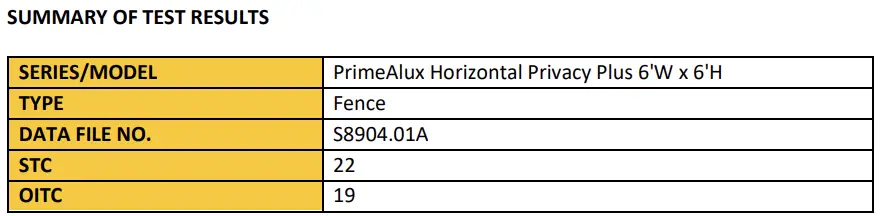
- PrimeAlux publishes Intertek results for a 6’W × 6’H PrimeAlux Horizontal Privacy Plus specimen: STC 22 and OITC 19.
- STC is commonly used for comparing assemblies (often aligned with speech range); OITC is intended to better reflect certain outdoor noise spectra with more low-frequency content.
- Real-world results depend heavily on installation details: bottom gaps, panel seams, gate clearances, and “sound going around the ends.”
- If you want better outcomes, think like a contractor: layout, alignment, and stable anchoring matter just as much as panel design.
Can a noise reducing fence really help outdoors?
Yes, it can help, especially for “everyday annoyance” noise. But it helps in a specific way: it works as a barrier. Outdoors, sound can bend over the top, reflect off hard surfaces, and travel around the ends of a fence run. That means you should expect a reduction in nuisance, not a guarantee of a specific decibel drop.
The best results typically come when:
- the fence blocks line-of-sight between source and listening area
- the fence surface is continuous (minimal openings)
- the install minimizes leakage paths (gaps)
What ASTM E90 actually measures
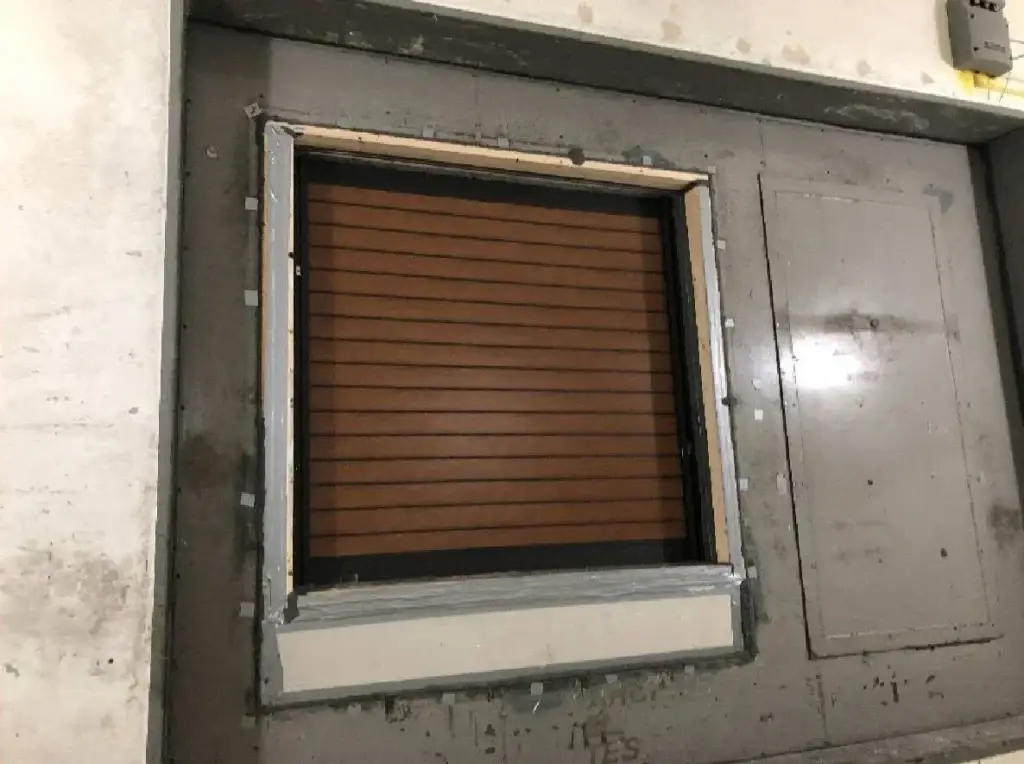
ASTM E90 is a standard laboratory method for measuring how much airborne sound is reduced as it passes through a specimen installed between two test chambers. The setup is designed so the specimen becomes the primary path sound travels between the rooms.
That’s valuable because it is repeatable. You can compare one assembly to another without guessing.
What it does not do: promise that your backyard will be “X percent quieter.” PrimeAlux even addresses this directly in their E90 FAQ. Outdoor sound behavior depends on site conditions and sound paths.
STC vs OITC, the two numbers people quote
PrimeAlux’s acoustic page explains both ratings in plain terms:
- STC (Sound Transmission Class) is a single-number rating commonly used to compare assemblies based on sound transmission loss data, often most relevant to speech-frequency ranges.
- OITC (Outdoor-Indoor Transmission Class) is another single-number rating derived from transmission loss data, intended to better reflect certain outdoor noise spectra, including more low-frequency content.
If your main complaint is neighbor voices, STC usually feels like the more intuitive metric. If your main complaint is traffic rumble or mechanical hum, OITC often deserves more attention because low-frequency energy behaves differently and is harder to block.
This is why a single number should never be the whole purchase decision. Use it as a comparison tool, then focus on layout and leak control.
PrimeAlux acoustic results, what was tested
PrimeAlux summarizes an Intertek laboratory report completed under ASTM E90 for a PrimeAlux Horizontal Privacy Plus (6’W × 6’H) specimen, tested at Intertek Building & Construction in York, Pennsylvania. The published ratings reported are STC 22 and OITC 19.
What that means for a fence buyer: the tested assembly shows measurable airborne sound reduction under controlled conditions. What it does not mean: your yard becomes “soundproof.”
How to make a noise reduction fence work in the real world
If you want your noise reduction fence to feel quieter, these field variables usually dominate:
1) Height and line-of-sight
A barrier works best when it blocks the direct path between the noise source (road, neighbor patio) and where you spend time (deck, seating, pool). If the source “sees” over the fence, you will still hear it clearly.
2) Airtightness, because gaps act like open windows
Small gaps can undermine the whole system. Watch for:
- bottom gaps from uneven grade
- panel seams that are not consistently closed
- openings around posts
- gate clearances and latch-side misalignment
3) Flanking paths, sound loves going around
If the fence run ends before it truly blocks the noise path, sound wraps around the ends. In many yards, adding returns (short perpendicular wings) or extending the run where noise is strongest improves perceived comfort more than upgrading panels.
This is where “acoustic fence panels” as a phrase becomes meaningful: it is less about the label and more about whether the design and installation reduce leakage paths.
What to look for in acoustic fence panels
In general, these design traits tend to support better sound reduction:
- a more continuous surface (fewer openings)
- interlocking or overlapping joints that limit leakage
- reinforced rails and stable posts that keep seams tight over time
PrimeAlux describes Privacy Plus as having interlocking inserts for a “completely closed design,” and includes reinforced rail structure in the product description and quick specs.
That matters because many “acoustic” gains disappear if a fence racks, twists, or gradually opens up seams after seasonal movement.
PrimeAlux also lists finish options on the product pages, including Walnut wood grain, Grey walnut wood grain, Yellow walnut wood grain, and Solid metallic color.
Contractor notes that actually affect sound outcomes
If you install fences, you already know the quiet truth: sound performance punishes small mistakes.
Post anchoring and stability
A fence that flexes or drifts can open micro-gaps over time. PrimeAlux’s installation steps emphasize base anchors, post alignment, and rail engagement as part of the assembly flow.
Post spacing and geometry
For noise outcomes, consistency beats improvisation. Verify layout early, keep bays square, and avoid “making it fit” differently every section.
Gate planning
Gates are commonly the weakest acoustic point because they need operational clearances. If noise reduction matters:
- reduce gate count on the noise side where possible
- avoid placing a gate right at the highest exposure point
- choose hardware and framing that resists sag
Slopes, retaining walls, and concrete edges
Grade changes create bottom openings. Plan stepped transitions carefully so you do not leave triangular gaps near the ground or use the racking option PrimeAlux provides.
What PrimeAlux does differently (supported facts)
- Publishes third-party acoustic test results under ASTM E90 for a specific configuration, including STC 22 and OITC 19.
- Privacy Plus is positioned as a closed design with interlocking inserts and reinforced rail structure in the product details.
- PrimeAlux states on its homepage that its aluminum fences are built to withstand winds over 170 km/h.
No hype needed. Documented testing and clear system design are already strong differentiators when a buyer is comparing options.
A noise reducing fence can make your yard noticeably more comfortable when you treat it like a barrier system, not just a decorative boundary. Use ASTM E90 results and STC/OITC numbers as comparison tools, then win in the field with height, continuity, and gap control. PrimeAlux’s published Intertek results for Privacy Plus (STC 22, OITC 19 for the tested 6 x 6 specimen) give you a real baseline to evaluate, while still keeping expectations realistic for outdoor conditions.
